
The scapegoat is easy. The pattern is the point.
Fire Blake Baker. Fine. Do it today, do it tonight, do it before you finish reading this sentence. Nobody in Canes Nation is going to stand outside the Hecht Athletic Center with a candle. When a defense gives up 62 points and lets North Carolina run for more than 500 yards — with two different backs each clearing 200 on the ground, off the same counter, over and over, all night — the coordinator is gone. That’s not a debate. That’s arithmetic.
But if you think firing him fixes Miami, you haven’t been paying attention to what actually happened on that field. Because the scary part of that game wasn’t the scheme. The scary part was that a professional football coaching staff watched an opponent run the exact same play into the exact same gap for four quarters and never once made them stop. That is not a play-call problem. That’s an organizational problem. Somewhere in that building, the mechanism that’s supposed to force a correction — the voice that says “we are changing this RIGHT NOW” — didn’t exist.
Adjustment is a culture, not a whiteboard
Here’s what people get wrong about in-game adjustments. Fans think it’s a chess move — coordinator sees counter, coordinator draws counter-to-the-counter, problem solved. It’s not. Adjusting mid-game is a chain of command under stress. A position coach has to be honest enough to say the front is getting displaced. A coordinator has to be secure enough to hear it without treating it as an attack on his call sheet. A head coach has to be present enough to walk down the sideline and demand a different answer when the first three didn’t work.
Every one of those links snapped in Chapel Hill. And you could see it snap in the smallest details. DJ Ivey out on an island with no safety over the top — that’s not a player failing an assignment, that’s the assignment itself failing the player. Nobody looked at the coverage and said, “we can’t ask him to do that against this.” Linebackers running clean, untouched, to the same landmark all night. That’s not effort. That’s a defense that had stopped being coached in real time and was just running the call.
And when that’s true for sixty minutes, it usually means it’s been true in some quieter, less humiliating form for months. Blowouts don’t create dysfunction. They reveal it. North Carolina just turned the lights on.
The tell was what happened after
Manny Diaz stood by his defensive coordinator, and then gave the team a week off practice. Read those two decisions next to each other, because together they say something specific.
Standing by a coordinator publicly, on its own, is defensible — you don’t blow up your staff in a press conference, you handle it internally, that’s normal. Giving a team a break after a brutal December in a brutal year, on its own, is defensible too. These kids have been through a season nobody signed up for.
But together, in the same 72 hours, after THAT? The message a locker room receives isn’t “we’re handling this internally” and it isn’t “you’ve earned some rest.” The message is: nothing that happened Saturday requires an immediate response from us. That’s the part that should terrify you. Not that Diaz protected his guy — that he apparently didn’t feel any urgency at all. A head coach who is genuinely furious finds a way to make the building feel it, even while saying all the right things to a microphone. Nobody outside that program felt anything.
“No dogs” is a recruiting problem AND a hiring problem
The phrase going around all week is that this team has no dogs. That the tackling is soft, the assignments are blown, and North Carolina players were literally reaching down to help Miami players up after hitting them. That last image is the one that’s going to live rent-free in this fanbase for a decade, because it’s not a stat, it’s a posture. That’s what a team looks like when it has accepted the terms of the game.
But “no dogs” gets said like it’s only about the roster, and that’s the lazy version. Players inherit their temperature from the staff. A defense doesn’t spontaneously decide to tackle with its shoulder pads down; somebody demands it every single day in practice until it’s involuntary, and somebody sits a starter the first time it isn’t there. If nobody on that staff has the standing or the stomach to bench a name-brand player for effort, then the standard isn’t real, and the players know the standard isn’t real long before we do.
So when the search for the next coordinator starts, the question can’t just be “who calls a good game.” It has to be: who will walk in that door with enough authority to make somebody uncomfortable in week one? A Miami native like South Carolina’s Travaris Robinson gets mentioned for exactly that reason — the guy has to be able to look a Dade County kid in the face and be believed. Recycling a familiar name off the hot-seat carousel — the Charlie Strongs and Will Muschamps of the world — is how you get a different voice saying the same tired things.
The bowl game is a trap either way
Miami’s headed to the Cheez-It Bowl, and the honest conversation nobody wants to have out loud is that there’s no outcome there that helps. Win it and it papers over everything — one decent night against a team with half its roster opted out becomes “we responded,” and the exact same defensive staff gets to sell that as evidence. Lose it big, especially to somebody like Oklahoma State or Florida, and you just take a second public beating with the same wound already open.
Which is why so many people around this program would genuinely rather eat the loss and move on. Not because losing is fun, but because a loss keeps the pressure honest. The worst thing that can happen to Miami is a comfortable, meaningless win that convinces the decision-makers the problem was one bad Saturday in Chapel Hill.
What actually has to change
The bar for this offseason isn’t a new coordinator. It’s proof that this program can identify a failure and act on it before the failure is national news. That’s it. That’s the whole test.
Everything else — the transfer portal moves, the draft departures that did their stock zero favors on that tape, the recruiting class, the schedule — is downstream of one question: when something is obviously broken at 8:40 PM on a Saturday, does anybody in that building have the authority and the nerve to fix it by 8:45? Right now, the answer we all watched is no. Blake Baker is the first name on the list. He shouldn’t be the last conversation.
Miami doesn’t need a new call sheet. Miami needs somebody with the juice to say “absolutely not” out loud and have it mean something. Until then, we’re just changing whose name is on the scapegoat, and the counter keeps hitting for eight.
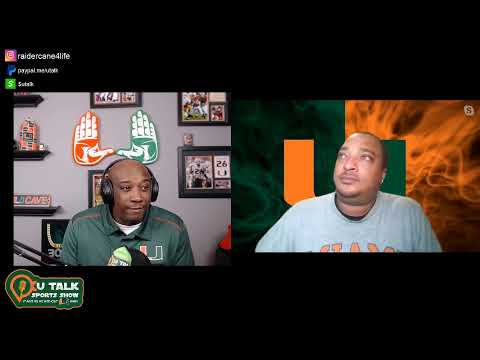
This take grew out of this week’s U Talk Live, where the mood in the room went well past the usual coordinator pile-on and landed somewhere a lot more uncomfortable. Worth your time if you want the raw version.
This take grew out of the December 15, 2020 episode — watch it here: Miami Hurricanes U TALK LIVE-69