
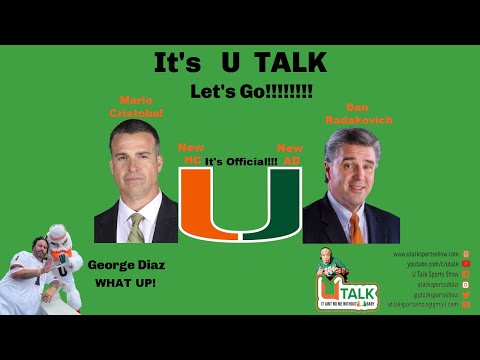
Ten years. Eighty million dollars. The number that flew around Coral Gables in the first week of December 2021 wasn’t a contract so much as a confession. Miami had spent a decade telling itself that the U was a self-executing brand — that you hang the turnover chain, you point at the Ring of Honor, you say the letter out loud, and the four-stars just show up because history is a recruiting pitch. Mario Cristobal’s deal is the University finally admitting out loud that the letter alone doesn’t pay. You have to fund it.
The Money Is the Message
Understand what a reported ten-year, eighty-million-dollar commitment actually communicates, because it is not primarily about the coach. Any school can overpay for a name. What a ten-year term says is: we are not going to blink in year three. It says the buyout math now cuts against the impatient boosters instead of against the coach. It says the next 6-6 season — and there will be a bumpy one somewhere in there, there always is — gets absorbed rather than weaponized.
Miami has not offered that kind of runway in the modern era. The program has run on a loop of hire-hope-panic-fire, and every cycle burned another two recruiting classes. Manny Diaz didn’t fail alone; he failed inside a structure that had never funded a real staff, never built the facilities arms race position, and never gave anybody the security to make a hard, unpopular, long-horizon decision. The eighty million is Miami buying its way out of its own worst habit.
And here’s the part that stings if you’ve followed this program: the money existed the whole time. It didn’t materialize in December. The donors who wrote this check could have written a smaller one three years ago. What changed wasn’t the balance sheet. It was the willingness to be embarrassed by not spending it.
The Portal Was Always Coming for Somebody. This Time It Came For Us — In a Good Way.
For years the transfer portal was a thing that happened to Miami. Guys left. Guys we developed left. Guys we out-recruited nationally decided the depth chart looked better in Tuscaloosa or Columbus, and we filled the hole with a body and called it a plan.
Watch what happens when a coach with genuine national pull walks in the door. Linebacker Justin Flowe — a former five-star, an Oregon centerpiece — enters the portal on Cristobal’s heels. A five-star tackle who’d been committed to Oregon reopens his recruitment the same week. That is not a coincidence and it is not luck. That is what it looks like when the coach is the recruiting asset rather than the school’s nostalgia.
This is the structural shift Canes fans should be sitting with. For a decade Miami recruited on inheritance. Cristobal recruits on relationship and on offensive line development and on a track record of walking into a room and being the most credible person in it. Inheritance runs out. Relationships compound.
Which is also why the Justin Medlock decommitment landing the same weekend as the Wesley Bissainthe commitment barely registers as news. In the old Miami, a three-star flipping out was a five-alarm fire on the message boards, because every departure was evidence of decline and there was no mechanism to replace him. In the new environment, roster construction has an actual second lever. You don’t need every high school kid to hold. You need a coach who can go get a proven player in January.
The Stadium Question Is the Real Test
Here’s the item that will still matter in five years when nobody remembers the details of this coaching search: the reported John Ruiz family pledge of three to four hundred million dollars toward a new on-or-near-campus stadium.
Miami’s single biggest competitive disadvantage has never been talent. South Florida grows more football players per square mile than anywhere on earth. The disadvantage is that Miami is a commuter program playing home games in somebody else’s building, twenty-something miles from the campus where the students actually live. You cannot manufacture a home-field environment out of a rental. Ask any recruit who took a visit on a Saturday and watched half-empty aluminum in the fourth quarter.
An on-campus stadium fixes something no coaching hire can fix. It turns a game day into a campus event. It turns students from a demographic you shuttle in into a demographic that walks over. It gives Miami what every program it wants to beat already has.
The skepticism is warranted, and it isn’t about the money. It’s about Coral Gables. This is a municipality with strong opinions about traffic, noise, height, and the general concept of eighty thousand people appearing on a Saturday. A pledge is not a permit. The hardest yardage in this whole story is not fundraising — it’s zoning. If Miami actually gets a site near campus approved, that’s a bigger long-term win than any single hire.
What Cristobal Inherits Before He Coaches a Down
The immediate wreckage is unglamorous. Miami is headed to the Sun Bowl against Washington State on New Year’s Eve with a coaching staff that is, charitably, unsettled. Manny Diaz is gone. Bowl prep in a transition year is a strange, half-real exercise — a lot of the roster is thinking about January, some of it is thinking about the portal, and whoever stands on that sideline is auditioning or babysitting or both.
Don’t read anything into that game. Seriously. Bowl results in a coaching transition are noise. The signal is in whose names appear on the staff by February, which portal players commit, and whether the offensive line room starts to look like something Cristobal built rather than something he inherited. That last one is the tell. His entire professional identity is built on the line of scrimmage. If the trenches don’t visibly change within two cycles, then the hire didn’t take.
Set the Right Expectation Now, Or Waste the Investment
The trap sitting in front of every Canes fan reading this: mistaking the excitement of December for a promise about next September. Miami just finished barely over .500. That roster does not become a playoff roster because the man in the headset changed. Culture installs slow. Line play installs slower.
What the fan base owes this hire — and what it has historically refused to give — is patience that matches the contract. The school committed to ten years. If the stands empty out and the radio calls turn ugly after one rough November, the eighty million was just an expensive way to repeat the same cycle with better branding.
The real recruit here isn’t Flowe or the tackle or whoever’s next. It’s Miami — the donors, the administration, the people in the seats — being asked to commit to something longer than a news cycle for the first time in twenty years. Cristobal is the easy part. He’s a known quantity and a proven builder. Whether the program around him has actually changed is the open question, and nobody gets to answer it until about 2024.
For once, though, the answer feels like it might be yes. That’s a strange sensation around here. Enjoy it carefully.
One More Thing
This take grew out of the conversation on this week’s U Talk Live, where the crew worked through the hire in real time — the money, the portal dominoes, the stadium pledge, and what it all means past the headline. Go listen to the whole thing; the arguments in the chat were half the fun.
This take grew out of the December 7, 2021 episode — watch it here: Miami Hurricanes U TALK LIVE-117