
Here’s the thing nobody wants to say out loud in the cop-versus-community argument: most of the people yelling at each other have never had to be both. They’ve been one or the other. Civilian or officer. Watched or watcher. And when you’ve only lived one side of a thing, you don’t have a position — you have a reflex.
Which is why the most useful voices in this whole mess are the ones who’ve had to hold both at once. A brother from the neighborhood who put on a uniform. Somebody whose family looks like the people getting pulled over and whose paycheck comes from the agency doing the pulling. That’s not a comfortable seat. That’s a seat where you catch it from everywhere. And it’s the only seat where the view is actually complete.
Combat Teaches You What Fear Actually Costs
Start with something that gets skipped in these conversations: a whole lot of American police work is staffed by people who went to war first. Infantry. Deployments. Riding out on missions in a Bradley Fighting Vehicle during the opening months of Iraq in 2003, coming home while somebody in your unit doesn’t.
People bring that up as a knock — the militarization argument, the “they’re trained for combat, not community” line. And there’s a real version of that critique. But there’s another read that gets almost no airtime, and it’s the one that actually matters.
Somebody who has been genuinely, existentially afraid — the kind where the fear is earned, where the threat was real and documented and lethal — usually has a much better calibrated sense of what a threat looks like than somebody who has never been tested. The person most likely to overreact to a hand moving toward a glovebox isn’t the veteran. It’s the one who’s never had to distinguish an actual threat from a nervous civilian, because his entire threat vocabulary is theoretical. Fear you’ve never metabolized is the most dangerous kind. It fires at everything.
That doesn’t excuse anything. Bad outcomes are bad outcomes regardless of resume. But if the conversation is going to be honest, it has to reckon with the fact that experience under real pressure and trigger-happiness are not the same trait, and often aren’t even correlated the way people assume.
The Age Question Is Asking the Right Thing the Wrong Way
Somebody called into this conversation with a proposal that comes up constantly: raise the minimum age for police officers above twenty-one. His reasoning was personal — a rough traffic stop as a teenager, riding in his uncle’s car, the kind of encounter that installs a permanent flinch in a kid.
I get the instinct completely. But I want to push on the mechanism, because I think the age framing is a proxy for something more precise.
What people actually mean when they say “too young” is “has never been anywhere.” A twenty-two-year-old who went straight from high school to the academy to a patrol car has a life catalog consisting of high school, the academy, and a patrol car. He’s never worked a bad job. Never been broke in a way that made him do something dumb. Never watched somebody he loved go through it. When he encounters a nineteen-year-old in a Honda at eleven at night, he has literally nothing in his own life to pattern-match against except training scenarios — and training scenarios are, by design, about danger.
Raising the age number alone doesn’t fix that. You’d just get twenty-five-year-olds with the same empty catalog. What fixes it is requiring the catalog: military service, real work history, a degree, years in a trade — something that put you in rooms with people unlike you before anybody handed you a badge and the authority to end a life. The age minimum is a crude instrument aiming at a real target. Aim better.
The Playbook Is Survival Advice, Not a Verdict on Justice
There’s a piece of advice that circulates in every Black household in America and gets argued about endlessly online. Slow down when the lights come on. Hazards on. Pull into a well-lit spot. Windows down. Hands where they can be seen. License already out before he walks up.
One camp calls it wisdom. The other calls it capitulation — why should I have to choreograph a performance to survive a busted taillight? Both camps are right, and they’re arguing past each other because they’re answering two different questions.
Question one: is it fair that this playbook has to exist? Absolutely not. It’s an indictment. The fact that a specific set of physical movements has been passed down through generations of Black families like a recipe is damning evidence about the country, not about the families.
Question two: given that it does exist, do you run it? Yes. Every time. Because the traffic stop is not the venue where the injustice gets resolved. Nobody has ever won a civil rights argument on the shoulder of the highway at midnight. The roadside is where you survive. The lawsuit, the complaint, the city council meeting, the ballot, the camera footage — that’s where you fight. Confusing the two venues is how people end up dead with a valid point.
Frame it as tactics rather than submission and the whole argument dissolves. You’re not conceding that the stop was righteous. You’re refusing to let a wrong stop become a fatal one.
The Uncomfortable Half of the Ledger
Now the part where a conversation like this earns its credibility or loses it: the willingness to name the thing that costs you applause.
There’s a popular line that violence within Black communities is a myth, a right-wing talking point, a deflection deployed whenever police accountability comes up. And the deflection version of it is absolutely real — plenty of people wield it purely to change the subject. But rejecting the deflection isn’t the same as rejecting the reality. Somebody who worked homicide cases for years, who stood in those living rooms, who made those notifications, is not going to pretend the caskets weren’t there.
Both things are true simultaneously. Police accountability is urgent. Neighborhood violence is urgent. Neither one cancels the other, and any argument that requires you to deny one to prosecute the other is a weak argument that will get shredded the moment it meets someone with firsthand knowledge.
Here’s the detail from that world that should be on a billboard: the number one pipeline putting guns onto the street is unsecured firearms left in cars. Not some shadowy trafficking network. Not a movie plot. Regular legal gun owners leaving a pistol in an unlocked console overnight, a kid pops the door, and now that weapon is in circulation forever. It will move through hands for years. It will show up at a scene.
That’s not a policy debate. That’s not left or right. That is a behavior, and it is fixable this week by individual people making a different choice at the end of the night. If you own a gun, don’t leave it in the car. That single habit does more measurable good than most of what gets shouted about online.
Why the Messenger Matters
The reason this lands coming from someone with dual citizenship in both worlds — and doesn’t land coming from a podium — is that he can’t be dismissed by either side’s usual move. The community can’t wave him off as an outsider who doesn’t know the block. The department can’t wave him off as a critic who’s never worn the vest. He’s got receipts in both directions, which means his criticism of each side has to be actually engaged with rather than sorted into a bin.
We don’t need more spokesmen. We need more translators — people who can carry a hard truth across the gap without softening it into uselessness on the way over. Those people are rare, they’re tired, and they take fire from every direction. Listen to them while they’re still willing to talk.
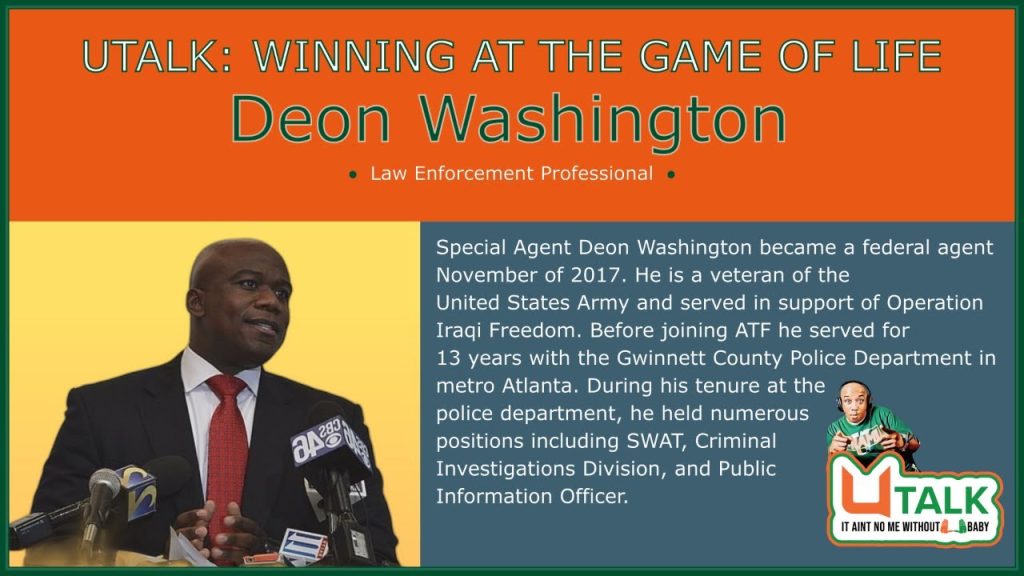
This take grew out of a conversation on this week’s episode of U Talk’s Winning at the Game of Life, where Devin and Larry Frank Jr. sat down with ATF Special Agent Deon Washington for an honest talk about the distance between law enforcement and the communities it serves. Worth your time in full.
This take grew out of the August 3, 2022 episode — watch it here: U TALK Winning at the game of life- Deon Washington Law Enforcement Professional