
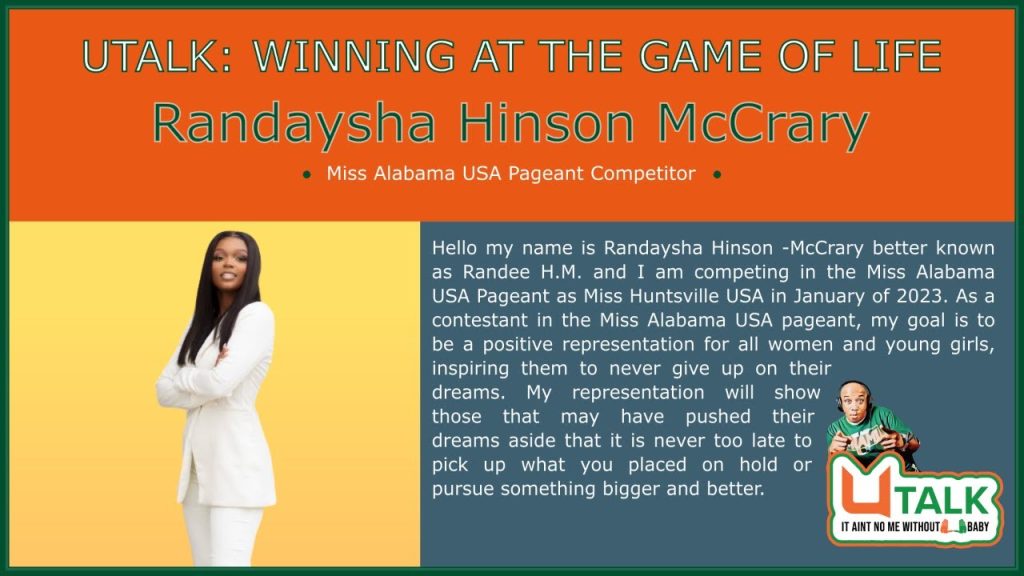
Every pageant contestant has a platform. Most of them are safe. Literacy. Clean water. Youth mentorship. Good causes, all of them, and nobody in the room ever has to shift in their seat. So when a 24-year-old out of Alabama walks into a Miss Alabama USA run with a mental health platform aimed squarely at the Black community, that is not a resume line. That is a choice with friction in it.
Randaysha “Randy” Hinson McCreary calls it A New Lease on Life. She is competing as Miss Huntsville in January 2023, with Miss USA and eventually Miss Universe stated out loud as the destination — no hedging, no “we’ll see how it goes.” But the part that deserves the airtime is not the crown math. It is that she built her whole run around normalizing therapy in a community that has spent generations being told to pray on it, tough it out, and keep the family business in the family.
Why This Platform Is Harder Than It Looks
Understand what she is actually up against. Pageantry rewards polish. It rewards the contestant who never looks like she is struggling, who answers the interview question with a smile that does not crack. The entire scoring apparatus is built on composure. And here comes a young woman whose message is essentially: composure is not the same as health, and pretending is not the same as being fine.
That is a genuinely strange thing to carry onto a stage that grades you on how effortless you appear. It requires her to hold two truths at the same time — perform at the level the competition demands, while telling the audience that performance is not the point. Most contestants pick a platform that sits comfortably beside their run. Hers sits in tension with the format itself. That is not a knock. That is the whole reason it lands.
The Detail That Gives It Away
Here is where you can tell she means it. Her definition of a valid mental health outlet includes singing off-key.
Read that again, because it is doing more work than it appears to. Art counts. Journaling counts. Singing badly counts. She is not selling a curated wellness aesthetic — no morning routine, no five-step protocol, no aspirational calm you have to buy your way into. She is saying that whatever gets it out of you is legitimate, including the ugly version, including the version nobody would put on a graphic. That is a deliberately low bar, and lowering the bar is the entire strategy. If the entry point to taking care of your head is a therapy appointment you cannot afford or a meditation practice you cannot maintain, most people never enter. If the entry point is a bad shower performance of a song you half know, everybody is already qualified.
People who have only read about mental health advocacy do not talk like that. They talk in clinical nouns. She talks in permissions.
The Credential Nobody Expected
She graduated from the University of Alabama with a degree in criminology and criminal justice, plus African American studies. She names that degree, not the sash, as her proudest accomplishment to date.
Sit with that combination for a second. Criminal justice and African American studies is not a set of electives you stumble into. That pairing is a person who chose to study, in detail, how systems process Black people — and then chose a public platform about mental health in that same community. Those two things are not separate interests filed in separate folders. They are the same inquiry approached from two directions. One asks what happens to people once the system has them. The other asks what is happening inside people long before the system ever shows up.
You do not have to connect those dots for her. She already lives at the intersection. But it explains why the platform does not read as a talking point. It reads as the applied version of what she spent four years reading about.
“No” as a Timestamp
Her operating philosophy on rejection is that a no is not a verdict — it is a not-yet. Every rejection is a redirect. She says she faces it daily.
That last part is the honest part, and it is the reason the philosophy is worth anything. Plenty of people can recite the redirect line. Fewer will admit they need it on a daily basis, which is a quiet acknowledgment that the reframe is not a personality trait she was born with. It is maintenance. It is a thing she does to herself, repeatedly, because the alternative is letting a stranger’s no become a fact about her worth.
She traces the framework to The Alchemist, her favorite book — a story that is fundamentally about a long journey where every detour turns out to have been the route. Fine. Books do that. But the useful move is not the citation, it is the conversion rate. She took a novel and turned it into a functioning defense mechanism she deploys on schedule. That is more than most people extract from a shelf of self-help.
The Family Was Already in the Building
Her father Jeff. Her mother Tanya Alexander. Her sister Kenisha, whose own pageant runs planted the idea in a much younger Randy’s head. Her stepmother Michelle in the corner too. Tanya’s description of her daughter — a go-getter from a small town, out of a family of engineers and medical professionals — is the piece that recontextualizes everything else.
Engineers and medical professionals. That is a family line built on precision, on credentials, on measurable outcomes. And the daughter coming up through it chose a lane where the scoring is subjective, the rejection is constant, and the product you are selling is yourself. That takes a specific kind of nerve, and it also explains where the discipline underneath the sparkle comes from. She is not improvising. She comes from people who finish things.
It also explains the platform’s credibility on a second level. When you come from a family of high achievers, you learn early how much pressure hides behind an accomplished exterior. You learn that the people who look most put together are frequently the ones nobody thinks to ask about. A mental health message from someone raised around that is not charity aimed downward at people who are struggling. It is a message aimed at the room she grew up in.
The Part That Outlives the Sash
Here is the bet worth making. Whatever happens in January — and the goal is stated all the way through to Miss Universe — the platform survives the result. A crown is a twelve-month appointment. A message about treating any form of self-expression as valid, delivered by a young Black woman with a criminal justice degree who admits she gets told no daily and reframes it anyway, does not expire on a schedule.
The competition will produce a winner. That is what competitions do. But somebody watching, who has been sitting on something heavy and has never been told that singing off-key in the car counts as doing something about it, gets that permission regardless of how the judges score. That is the part that does not need a sash to work.
This take grew out of this week’s U Talk: Winning at the Game of Life, where Devin held down a special Tuesday edition solo and sat with Randy for a conversation that got past pageant prep in a hurry.
This take grew out of the December 14, 2022 episode — watch it here: U TALK Winning At The Game Of Life- Randaysha Hinson -McCrary