Here’s the thing nobody puts on the onboarding slide deck: the coverage you got handed on day one of your job was built around one very specific event. You dying. That’s it. That’s the product. Everything else you assume it does — carry you through a rough stretch, keep the lights on while your body puts itself back together — is something you filled in yourself because nobody corrected you.
And on the U Talk network this week, that assumption got taken apart in front of everybody. Not with a sales pitch. With a story.
Four Months In, the Money Stopped
Larry Frank Jr. — the same voice you hear holding down the desk on this network — told it straight. His wife had a mild heart attack. Mild. That’s the word that should scare you, because “mild” is the version everybody survives and nobody plans for. She was out of work six months. Her employer benefits ran dry at month four.
Do the math on that gap. Two months. Two months of a household running on one income, with a recovering spouse who cannot rush the process, and a mortgage company that does not have a compassion department. Nobody in that scenario did anything wrong. She worked. She had benefits. She got sick and survived. And the system still handed her a two-month hole to fall into.
That’s not an edge case. That’s the design.
The Uncomfortable Truth About Surviving
Modern medicine has gotten scary good at keeping people alive. Heart attack, stroke, cancer — these used to be endings. Now, increasingly, they’re interruptions. Long, expensive, exhausting interruptions.
Which means the financial product most of us carry is aimed at the outcome that’s become less likely, while the outcome that’s become MORE likely — you make it, but you can’t work for half a year — has no product pointed at it at all. You survive the thing that could’ve killed you and then the bills try to finish the job.
Dominique Bland calls the traditional stuff “death insurance,” and that phrase lands because it’s not an insult, it’s a spec sheet. That’s literally what it’s engineered to do. One trigger. One payout. One beneficiary who isn’t you.
The alternative he’s pushing — living benefits — flips the trigger. Get the diagnosis, and you can accelerate the death benefit to yourself while you’re still here to spend it. Not extra cost. Built in. Because, as he put it, bills don’t care about your health. Medical debt is still the leading cause of bankruptcy in this country, and it’s not primarily bankrupting dead people. It’s bankrupting survivors.
Why Nobody Told You This
Fair question. If this is real, why is it news?
Here’s a number that explains a lot: roughly 105,000 active licensed agents nationally. In a country of 340 million people. And about nine percent representation from our community inside that already-small number.
Sit with that. The people whose job it is to walk into a living room and explain the difference between a policy that pays your family after and a policy that pays YOU during — there are almost none of them, and there are vanishingly few of them who look like the neighborhoods that get hit hardest by exactly the health outcomes we’re describing.
This isn’t a conspiracy. It’s a distribution failure. The information exists. The products exist. The messengers don’t. So the default happens — you take the group plan through work, you never read past page two, and you find out what it actually covers on the worst week of your life.
The Employer Isn’t the Villain, But They’re Not Your Friend Either
Bland’s shot at the 401(k) was the part of the night that made people sit up. Taxed on the way out. Gated behind hardship rules if you need it early. Fully exposed when the market takes a dive. And the line that did the damage: it wasn’t designed for us to benefit, it’s a tax write-off for the employer.
You can argue the nuance. But the structural point is hard to dodge — every one of those features benefits the entity offering it before it benefits the person contributing to it. And the tax logic he lays out is the kind of thing that should be taught in high school and isn’t: you can pay tax on the seed or pay tax on the harvest. One of those numbers is small right now. The other one is whatever a future government decides it is.
Same principle applies to the benefits package. It’s not that your employer is scheming against you. It’s that your employer built a package around their liability window, not around your recovery timeline. Those two things overlap for about four months and then they don’t. Ask the Frank household.
The Staircase Versus the Roller Coaster
The other piece worth carrying home is the visual Bland used for the Indexed Universal Life policy, the one he calls the Ferrari of the lineup. Picture the stock market — that jagged line, up, down, panic, recovery, panic again. Now picture a staircase. Steps up, or flat. Never down.
That’s the pitch: market-linked gains, zero participation in the losses. Tax-free growth, tax-free borrowing against it, doesn’t report as earned income. Whether it’s right for your specific situation is a conversation with a licensed human being, not a column. But the concept deserves to be in your vocabulary, because right now most people’s entire mental model of building money is “the number goes up and sometimes it goes down and I just have to eat it.”
What Actually Costs You
Here’s what I keep coming back to. The barrier to entry on the other side of this — actually becoming one of those 105,000 — is a licensing test you pass with a 70, and there’s no math on it. No math. The thing keeping people out of an industry that could change their family’s trajectory is not aptitude. It’s that nobody in their life ever mentioned the door existed.
Bland’s own path says the same thing. Kid pushing a lawnmower through the neighborhood. Teen father. Built a carpet-cleaning business at 21 and ran it for two decades. Got licensed during COVID lockdown — and then refused to use the license until he found mentors, because he wasn’t willing to fumble somebody’s livelihood while he learned. That’s a man who understood the weight of what he was holding before he picked it up.
The lesson isn’t “go buy an IUL.” The lesson is that the gap between what you think you’re covered for and what you’re actually covered for is a document you can read tonight. Pull the plan. Find the disability provision. Find the month it stops. Write that number down.
Then decide whether your household can survive it. That’s the whole assignment.
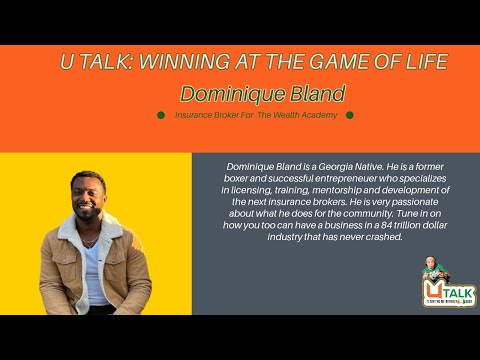
This take grew out of this week’s Winning at the Game of Life edition on the U Talk network, where Dominique Bland sat down with Devin and Larry Frank Jr. for an hour that went a lot deeper than anybody expected on a Wednesday.
This take grew out of the January 30, 2025 episode — watch it here: U TALK Winning At The Game Of Life-Dominique Bland