
Let’s get the easy part out of the way: the bar for Miami football in 2026 is a national championship. Nobody around this program is pretending otherwise, and nobody should. When you get that close and lose, the only honest goal left is finishing it. Fine. Bar set. Everybody nod.
Now here’s the uncomfortable part nobody wants to sit with while the offseason hype is warm and the recruiting graphics are still dropping: this team’s ceiling is not going to be determined by the quarterback, the receivers, the defensive line, or the coordinator you’ve been arguing about on Twitter. It’s going to be determined by five guys, most of whom you can’t name yet, who are going to be asked to hold up under playoff pressure with barely any collective experience doing it.
Twenty-Five Starts Is Not a Talking Point, It’s a Countdown Clock
Here’s the number that should be taped to the inside of every Cane fan’s eyelids. Ohio State walked into last season with an offensive line carrying eighty-five combined career starts. Eighty-five. That’s a group that had already seen every stunt, every twist, every late-game blitz look a defensive coordinator could throw at them, and had already been wrong together enough times to stop being wrong.
Miami’s projected five for 2026? Fewer than twenty-five combined starts.
Sit with that gap. That’s not a small difference in resume — that’s a different species of unit. Sixty career starts is roughly five full seasons of Saturday reps spread across a room. It’s the difference between a line that communicates and a line that hopes. And the cruel thing about offensive line play is that it’s the one position group where individual talent is the least reliable predictor of performance. You can have five future pros up front and still get a guard and a tackle passing off the same looper while a linebacker walks free into your quarterback’s chest. Talent doesn’t fix that. Only reps fix that. Only time fixes that.
So when people say Miami is loaded — and Miami is genuinely loaded — the honest follow-up is: loaded everywhere the ball ends up, but green everywhere the ball starts. Every explosive play this offense is capable of has to survive the first 1.8 seconds. That’s the whole conversation.
Why This Is the Coordinator Debate, Actually
There’s been plenty of arguing about Shannon Dawson and whether the offense is calibrated right. Both coordinators got extensions this offseason, and the reaction to those was, let’s say, not uniform. But I’d argue most of that debate is being had at the wrong altitude.
The real question isn’t whether Dawson’s playbook is good enough. It’s whether the play-calling is going to be built to protect a young offensive line or built to expose it. Those are two completely different offenses that can be run out of the same binder.
An offense that protects a young line lives in quick game, uses motion and formation to declare the defense’s intentions before the snap, leans on the run to keep third downs short, and rolls the pocket to cut the field in half so five inexperienced guys only have to be right on one side. An offense that exposes a young line calls seven-step drops on third-and-eight, waits for routes to develop against a four-man rush, and asks a redshirt sophomore tackle to win one-on-one for four full seconds against a first-round edge. Same coordinator. Same weapons. Completely different outcome in January.
That’s the thing I’ll be watching for in September, and it’s a much more useful lens than a blanket verdict on any coach. Watch how fast the ball comes out. Watch how often Miami is in second-and-manageable. Watch whether the run game is used to set up the pass or to bail out the pass. Those tell you whether the staff has correctly diagnosed its own roster.
The Good News Is Structural, Not Emotional
Now let me flip it, because I’m not here to be the guy who finds the cloud in front of the sun.
The reason Miami has a real shot in 2026 isn’t vibes. It’s that the roster has finally been built the way this place used to build them: three deep. The most underrated development in the program isn’t the top of the recruiting board, it’s the middle. Four- and five-star kids are choosing Miami while looking directly at a depth chart that has established talent stacked in front of them. That’s not normal in the current era. In the transfer-portal economy, the standard behavior is to chase the clearest path to snaps. When elite recruits start choosing the hardest path instead, it means they believe development here is worth more than early playing time somewhere else.
And that specific dynamic is the only thing that actually solves the offensive line problem. Not a portal splash. Not a scheme tweak. Depth. Because young lines don’t get experienced by wishing — they get experienced by surviving. The five guys who open the season are going to be sharper in November than they are in September, and if the sixth, seventh, and eighth guys are legitimate players rather than emergency options, then the inevitable injury doesn’t collapse the whole operation.
The other quiet advantage: continuity. Keeping both coordinators means nobody spends August installing a new language. For a line room that needs every rep it can get on communication and identification, a returning system is worth more than it would be for almost any other unit on the roster. The guys who’d benefit most from a coordinator change are the ones who need the fewest reps. The guys who need the most reps benefit most from nothing changing. Miami’s roster is stacked toward the second group.
The Real Test Is a Date, Not a Debate
Circle November 7. South Bend. That is the game where everything in this column gets graded. By that point in the 2026 season, the excuse window has closed. Whoever is playing left tackle has enough starts to be counted on. The offense either has an identity that protects itself or it doesn’t. And Notre Dame’s home crowd is exactly the environment that punishes a line that communicates with words instead of with instinct — you can’t call out a protection adjustment if nobody can hear you.
That’s why the trip north is the season’s honest checkpoint. Not because of what a loss would do to the playoff math, though it would do plenty. Because it’s the first road environment where a young front has to be a veteran front, and there’s no scheduling around it.
Championship or bust is a fine slogan. I like the confidence. This program has spent too long being modest about itself, and there is a version of this team that runs the table because the talent gap is real and the culture has flipped. But if it happens, the highlight reel is going to be the skill guys, and the actual reason is going to be five guys who grew up fast between September and November.
Watch the trenches. Everything else is downstream.
One More Thing
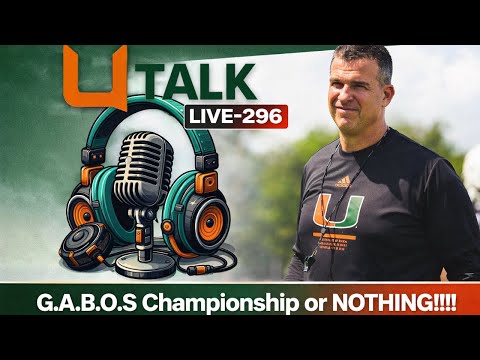
This take grew out of this week’s U Talk Live episode, where the crew came back from hiatus and put the season’s stakes on the record. The stat that set this whole column in motion — eighty-five combined starts versus fewer than twenty-five — came up on that show, and it’s been rattling around my head ever since. Go listen to the full conversation.
This take grew out of the April 18, 2026 episode — watch it here: Championship or Bust for Miami Hurricanes Football?! | U TALK LIVE-296