There’s a version of the sports business everybody thinks they know. Agency towers. Glass conference rooms. A guy in a suit sliding a contract across a table while a 22-year-old kid tries to look like he understands the language. That’s the picture. That’s the movie.
Here’s the reality nobody puts on the poster: for every athlete who makes it to that table, there’s somebody who had to cold-call fifty offices to be allowed in the room at all — and got told no fifty times.
Quintarius “Q” Queen got told no. Every agency. Every agent. He wasn’t asking for a job, mind you. He was asking for an internship. Free labor. The lowest rung on the ladder, the one that exists specifically so young people can climb onto it. Locked. Every single one.
So he built his own ladder and named it Clever Sports Group.
The Part Where the Story Should Have Ended
Understand what should have happened next, because it happens to thousands of people a year and you never hear about any of them. The normal ending is: kid with the sports administration degree takes a job that has “analyst” in the title, tells himself it’s a stepping stone, and eventually stops telling himself that. The dream doesn’t die dramatically. It gets a 401(k) and quiets down.
Q had every ingredient for that ending. He had the credentials — LSU, bachelor’s in sports administration, MBA in finance. He had real institutional experience, having worked inside the LSU athletic department during a stretch when that building was in genuine turmoil. He’d already made the hard pivot once, running track at UNO before transferring. He was, by every measure a résumé can capture, qualified.
And the industry still said no.
That’s the detail that should stick with anybody reading this. It wasn’t a talent gate. It wasn’t a preparation gate. It was an access gate — the kind that has nothing to do with whether you can do the work and everything to do with whether somebody already inside decides to reach a hand back. Sports has always run on that. Who you know, who vouched, whose nephew you are. The credentials are the cover story; the relationship is the actual currency.
Q’s response wasn’t to complain about the gate. It was to notice that the gate only controls one entrance.
Why the Klutch Comparison Is Bigger Than a Logo
Clever Sports Group is a five-letter name. Klutch Sports is a five-letter name. The logo echoes. Q will tell you straight up that Rich Paul is the blueprint, and he’s not being coy about the homage.
Some people will read that as imitation. They’re missing it completely.
What Rich Paul actually proved wasn’t that a guy from Cleveland could get rich. It was that the credentialing structure of the sports agency business was, in significant part, theater. That an agency’s power came from its client list, not its letterhead. That if you had the relationship and you did the work, the tower didn’t have leverage over you — you had leverage over the tower. He collapsed a whole mythology by simply operating outside it and winning.
Once somebody does that publicly, it stops being a fluke and starts being a map. Q reading that map and naming his shop in the same cadence isn’t copying. It’s citation. It’s a young founder saying out loud: this is the lineage I’m claiming, this is the proof-of-concept I’m running on. Every movement needs a first guy and then it needs the people who saw the first guy and thought, oh — that’s allowed?
And critically, Q didn’t launch with a fantasy client list. He launched with one guy. Ranz. First client, real client. That’s how actual businesses start — not with a splash, with a person who trusted you before there was any reason to.
The Licensing Maze Nobody Explains to Kids
Here’s something Q lays out that deserves way more daylight than it gets, because it explains a huge amount about why this industry stays closed.
To get NFLPA certified, you need a master’s degree and roughly $2,500 for the exam. NBPA is a lighter lift — bachelor’s, around $1,500. Those numbers aren’t catastrophic on their own. But stack them: you need a graduate degree, which means graduate tuition, which means either family money or debt, and then a four-figure exam fee, and then you need clients, which requires years of relationship-building you’re doing while not getting paid.
Now go back to the top of this column. Remember that every agency told him no on the internship. The unpaid on-ramp was closed, and the paid on-ramp required a master’s degree.
That’s not a filter for competence. That’s a filter for who can afford to wait.
Q also flags a workaround that a lot of aspiring agents genuinely don’t know exists: an unlicensed “agent advisor” can do the day-to-day work under a licensed partner. Recruiting, servicing, relationship management, the actual grind of the job — all available before you have the paper. That is a legitimate side door, and the fact that it’s not common knowledge is itself telling. Doors nobody advertises stay uncrowded.
The NIL Argument, and Why It Lands Harder From Him
College athletes are on the verge of finally being able to earn off their own names. As of this summer of 2021, the wall is cracking. And you’re going to hear a lot of takes about it from people who’ve never once wondered where their next meal was coming from.
Q’s version cuts different because his version isn’t about endorsement ceilings or market efficiency. It’s about kids going hungry between meals. Athletes — especially the ones who came from nothing — sitting on campus, generating revenue for an institution, legally barred from earning a dollar, and physically hungry.
That’s the argument. Not “players deserve their market value,” though they do. The floor argument: a person producing that much value should not be hungry. When you frame it that way, the decades of hand-wringing about amateurism look less like principle and more like an excuse that got very comfortable.
Find the Light Bulb
The thing Q keeps returning to is what he calls the light bulb moment — the specific thing you’re actually built for, as opposed to the thing you assumed you’d do.
His example is Ray Allen and the three-point shot. Allen didn’t arrive knowing that was the answer. He found it, and then he organized an entire Hall of Fame career around it — the footwork, the conditioning, the obsessive routine, all of it downstream of one recognized truth about himself.
Q was, by his own telling, one of the smallest dogs with the biggest bark on the field. The bark was real. The size wasn’t going to change. So the light bulb wasn’t “play harder” — it was recognizing that the same competitive engine that made him loud on the field would run better on deal-making than on playing.
That’s the harder version of the advice. Everybody says follow your passion. Almost nobody says: your passion might be pointed at the wrong position, and the courage isn’t in persisting, it’s in the pivot.
He got told no by an entire industry and built his own shop anyway. Nothing about that requires permission. It just requires knowing exactly what you’re for.
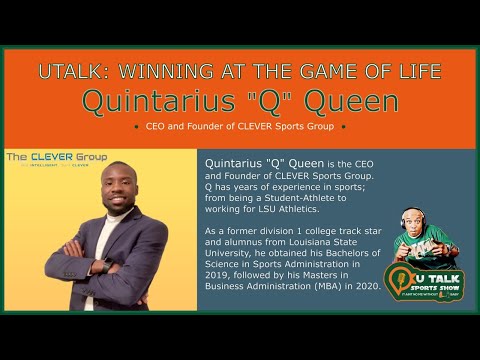
This take grew out of this week’s U Talk conversation, where Larry Frank Jr. sat down with Q Queen — a kid he coached back in middle school, now running his own agency.
This take grew out of the June 8, 2021 episode — watch it here: U TALK Winning at the game of life- Quintarius “Q’ Queen CEO and Founder, CLEVER Sports Group