
Here is the thing nobody tells you when you grow up loving sports: the arena teaches you how to talk. It just teaches you the wrong vocabulary.
Think about how fluent we are. A Black man who cannot say the words “I am not okay” out loud to his own brother can give you a fifteen-minute breakdown of a pick-and-roll defense. He can tell you exactly what went wrong in a fourth-quarter possession, diagnose a quarterback’s footwork, explain why a bullpen decision was malpractice. He has an entire analytical language sitting in his chest, sharpened over decades. And he cannot use one word of it on himself.
That is not an accident. That is training.
Sports Is the Escape. Then the Game Ends.
The line that has been rattling around in my head all week is a simple one: sports is our escape from life, but when the game is off, life recommences. Read that again. The escape has a clock on it. Three hours, maybe four with overtime. Then the broadcast cuts to a car commercial and you are sitting in your living room with everything you were avoiding, and it did not go anywhere. It waited.
We treat this as normal. We treat it as harmless. And mostly it is — there is nothing wrong with a man needing somewhere to put his attention for a few hours. But somewhere along the line, the escape stopped being a break and started being the whole strategy. The game is not a coping mechanism. It is a delay.
In 2022, we are finally saying that part out loud, and it is uncomfortable, and it should be.
“Man Up” Is a Coaching Instruction We Never Retired
Every Black man reading this heard some version of it. Fall down, get up, do not cry, shake it off, be tough. And the wild part is that it works — in the specific, narrow context of a game. Shaking off a rolled ankle to finish a possession is admirable. Playing through a bad night is professional.
The problem is that nobody ever told us the instruction had a boundary. Nobody said “this applies between the lines and nowhere else.” So we took a sideline command and installed it as the operating system for an entire life. Grief? Shake it off. Divorce? Play through it. Watching your father disappear, watching your friend get buried, watching your own kid look at you the way you used to look at somebody who scared you? Man up.
And then we wonder why grown men are walking around carrying twenty years of unprocessed film with no coaching staff, no review session, no game plan. You cannot fix what you refuse to watch back.
There is a second layer to it, too, and it is nastier. A lot of us were told, way too young, that we were “the man of the house.” That sounds like a promotion. It is actually a job handed to a child with no training, no support, and no exit. A ten-year-old gets told he is the man now, and he spends the next thirty years running an operation he was never qualified for and never got to quit. Then he becomes a husband, a father, a boss, and every single relationship gets filtered through a responsibility he never chose.
The Tough Guy Trap Is a Rigged Game
Here is where it gets truly unfair, and this is the part that people outside the experience genuinely do not understand.
The standard advice for a man struggling is: speak up. Use your words. Tell somebody. Fine. Except a Black man who speaks up frequently does not get heard — he gets labeled. He gets called angry. He gets called difficult, aggressive, a problem, not a team guy. The same honesty that gets one man praised for vulnerability gets another man written up.
So you learn. Quickly. You learn that silence is the lower-cost option. You learn to perform steady. You learn to walk into work with your face arranged and your voice modulated and every real thing about your day sealed shut, because the alternative is being treated as a threat for having a feeling.
That is not a personal failure of communication. That is a rational response to a rigged game. And any conversation about Black men and mental health that does not start there is going to be useless, because it will end up telling men to do something the world has already punished them for doing.
The Checklist Before the Front Door
Now put a layer on top of that. Before some Black men leave the house — before the workday even starts — there is a whole internal protocol that runs. What am I wearing. What am I driving. What route am I taking. Where are my hands going if I get pulled over. What is my voice going to sound like. Who do I call.
That is a mental load. A real, measurable, energy-consuming load, running in the background of a man who then walks into a job and is expected to be pleasant, present, and productive. And when he is short with somebody at three in the afternoon, nobody connects it to the calculation he ran at seven in the morning. Including, half the time, him.
This is what makes the “just relax, it is not that deep” response so infuriating. For a lot of guys it is genuinely not paranoia. It is preparation. And preparation for danger, repeated daily for decades, does something to a nervous system whether you name it or not.
What Everybody Got Wrong About the Slap
Which brings us to the thing everyone has been arguing about for two weeks. The Will Smith and Chris Rock moment at the Oscars became content within about ninety seconds — memes, hot takes, jokes, everybody picking a team.
Almost nobody asked the actual question. What happens to a man who was never given anywhere to put his pain? Where does it go? It does not evaporate. It accumulates, quietly, with interest, until something small pulls the trigger on something enormous, and the world watches the explosion and judges the explosion, because the explosion is the only part that was ever visible.
That is the whole thesis. You do not get to a moment like that in one night. You get there over a lifetime of nobody asking, and a lifetime of you making sure nobody had to.
Everybody watching had an opinion about the ten seconds. Nobody had a question about the forty years.
The Actual Assignment
So what do you do with this. Not a hashtag. Not a graphic. Something smaller and harder.
Ask a man you love a second question. He says he is good — everybody says they are good, “good” is the reflex — and instead of moving on to the game, you ask again. Ask what work has been like. Ask about his pops. Ask what he has not said out loud to anybody. And then do the part that actually costs something: shut up and let the silence sit there until he fills it.
And go first. That is the move that unlocks it. Men do not open up in response to an invitation, they open up in response to an example. Somebody has to be dumb enough to say the true thing first, and it might as well be you.
We have built an entire culture around men talking to each other about performance. Wins, losses, stats, strategy. All of it about somebody else’s body doing something on television. We are very good at it.
Imagine if a fraction of that fluency got pointed inward. Imagine a man breaking down his own week with the same detail he brings to a box score. That is not softness. That is film study. Every great competitor in history watches the tape.
Watch your own tape. That is the whole ask.
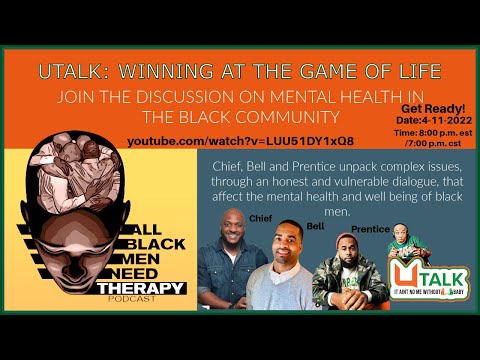
This take grew out of this week’s U Talk Winning at the Game of Life, where the crew sat down with the hosts of All Black Men Need Therapy for a conversation that went a lot deeper than anybody planned. Go find it.
This take grew out of the April 12, 2022 episode — watch it here: U TALK Winning at the game of life- Chief, Bell & Prentice All Black Men Need Therapy