
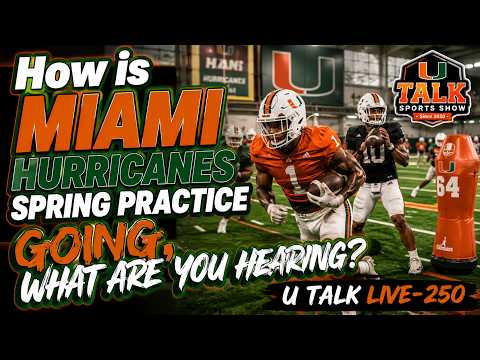
Let’s be honest with each other, Canes family, because that’s what The Rundown is for. Every March, the same thing happens. Somebody comes out of Coral Gables practice with a report about a freshman who can’t be covered, a linebacker who’s flying downhill, a secondary that suddenly looks like it belongs in the ACC. The buzz builds. The timeline gets loud. And then September rolls around and we’re all sitting there watching a tight end run free down the seam wondering how we got fooled again.
So when the reports out of this spring are glowing — and they are — the question isn’t whether the talent is real. The question is whether Miami has earned the right to be believed. Right now, in March of 2025, the honest answer is no. Not yet.
The Practice-Report Economy Is Broken
Here’s the structural problem nobody wants to name: spring practice reporting is the only part of the football calendar with zero accountability. Nobody keeps a ledger. If a guy gets written up as unguardable in March and disappears in October, there’s no correction issued, no follow-up, no reckoning. The hype gets minted, spent, and forgotten before anyone can audit it.
That’s not a Miami problem, it’s a college football problem. But Miami has a specific version of it, and it’s been compounding for over a decade. This program has been “back” more times than a bad sequel franchise. Every spring produces a new crop of names that are going to change everything, and every fall produces the same fundamental failures — busted coverages, missed tackles in space, an inability to get off the field on third down when the game is actually on the line.
So the fan who says “I don’t want to hear it, show me an ACC title” isn’t being negative. That fan is being rigorous. That fan has run the experiment enough times to know the results.
What Actually Deserves Optimism (And Why It’s Different)
Here’s where I’ll break from pure cynicism, though, because there’s a distinction worth drawing between two kinds of spring buzz.
The first kind is player hype — Player X looks amazing, Player Y put on fifteen pounds, Player Z is a leader now. This is the cheapest currency in football. It’s real in the sense that somebody genuinely saw something, but it’s non-predictive because practice is a controlled environment. You don’t know if the receiver is beating a great corner or a walk-on. You don’t know if the pass rusher is winning against a starter or a redshirt. The signal-to-noise ratio is awful.
The second kind is structural change — new coaching, new scheme, new approach to how the unit is taught. And this is genuinely a different animal, because you can evaluate it before a snap gets played.
Miami’s making structural changes on defense. New coordinator. New voices coaching the front seven. A reported philosophical shift toward simplifying what the defense is asked to do. That last part matters more than any individual player report, because Miami’s defensive failures in 2024 were not primarily talent failures. They were communication failures. Guys looking at each other after a big play. Nobody sure who had the deep half. Pass rush arriving a half-second late and turning a manageable throw into a catastrophic one.
You do not fix that with a five-star. You fix that with clarity. If the reports about simplification are accurate, that’s the single most encouraging thing to come out of this spring — not because it guarantees anything, but because it’s a coherent response to the actual diagnosed problem.
The Difference Between Hope and Evidence
I want to be careful here, because it’s easy to swap one form of hype for another. “The scheme is simpler” can become its own unfalsifiable talking point if we let it.
So let’s define what evidence actually looks like, and let’s define it now, in March, before anybody can move the goalposts.
Evidence is third down. Not yards allowed, not points allowed — those are contaminated by field position, turnovers, and garbage time. Third-down stop rate is the closest thing football has to a pure test of whether a defense understands its assignments under pressure.
Evidence is explosive plays allowed. Specifically the deep shots. A defense that busted coverage in 2024 and doesn’t bust coverage in 2025 has demonstrably improved communication, and you can see it with your eyes without needing a stat sheet.
Evidence is the fourth quarter of a road game against a real opponent. Not the September cupcake. Not the home game where the crowd carries you. The one where it’s tied late, the stadium is against you, and the defense has to get one stop. That’s the test Miami has failed over and over. That’s the only test that counts.
Write those three down. Come back in November. If Miami hits all three, the spring reports were real and I’ll say so loud. If Miami misses all three, then we’ll know the buzz was just buzz — again.
The Bill Comes Due in 2025
Here’s the part that makes this spring different from the last several, and it has nothing to do with any freshman.
The patience is gone. Not fan patience — that’s been gone for years and it hasn’t mattered. I mean the structural patience. Miami has now had enough time, enough resources, enough recruiting wins, and enough roster turnover that “we’re building” has stopped functioning as an explanation. At a certain point the building phase either produces a building or it doesn’t.
The 2025 season is where that gets settled. Not settled in the sense of a coaching decision necessarily — that’s above my pay grade and it’s not what I’m calling for. Settled in the sense that we finally get an honest reading of whether this thing is trending up or whether it’s plateaued at “good enough to be interesting, not good enough to matter.”
And I’ll say this too, because it cuts the other way: some of the criticism aimed at individual guys has been unfair. When a player produces at a high level as a freshman and then plays hurt through most of the following season, calling that a sophomore slump is lazy analysis. Injuries are not regression. If a guy fought through a season banged up and still affected games, that’s a data point in his favor, not against him. We can demand accountability from the program without turning young players into the scapegoats for institutional failures.
Where That Leaves Us
Two weeks from now the spring game gives us our first look. And I’ll tell you right now what the spring game will prove: almost nothing. It’s a glorified scrimmage in shorts-and-shells energy where nobody wants to get anybody hurt. Enjoy it, go see your team, get a read on some names. But don’t come out of April 12 thinking you learned something load-bearing.
What I want from Canes fans this spring isn’t cynicism and it isn’t blind faith. It’s patience with a deadline. Believe what the coaches are doing structurally, because the diagnosis looks correct and the response looks coherent. Withhold judgment on the individual hype until it faces a real opponent. And keep the receipt on the specific things you were promised, so that when the fall comes, the conversation is about what happened rather than about what somebody said in March.
That’s not being a hater. That’s being a fan who’s been paying attention.
This take grew out of this week’s U Talk Live conversation about what’s coming out of Miami’s spring camp, where the panel and the callers spent a lot of time circling the same tension between glowing practice reports and a fan base that’s tired of being sold on potential. Full episode is worth your time.
This take grew out of the March 22, 2025 episode — watch it here: MIAMI HURRICANES SPRING PRACTICE: HOW IS IT GOING & WHAT ARE YOU HEARING? | U TALK LIVE-250