
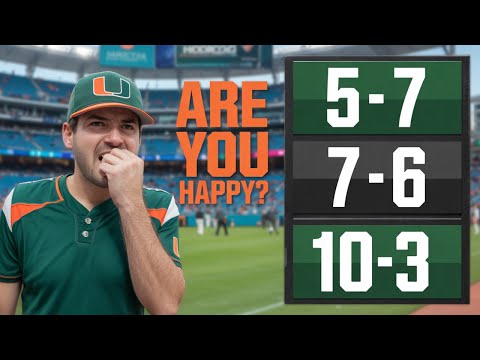
Let’s be honest with each other, because that’s what this space is for. When somebody asks a Miami fan in June of 2025 whether they’re happy with Mario Cristobal, the honest answer isn’t yes and it isn’t no. The honest answer is a question of its own: happy compared to what?
Because that’s the trap. Ask a fan who lived through the Manny Diaz years whether things are better, and of course they are. Ask a fan who remembers what it felt like when Miami played in January and the answer is a shrug. The Cristobal debate has been argued badly for two years now because both sides are grading different tests. One side is grading the roster. The other side is grading the scoreboard in the fourth quarter. And here’s the thing nobody wants to say out loud — both sides are right, and that’s exactly why this is so uncomfortable.
The Two Miamis
There are two versions of this program running at the same time, and they barely know each other.
Version one is the acquisition machine. That Miami is elite. That Miami walks into a living room in South Florida and walks out with a signature. That Miami has assistant-coach money that no previous staff in Coral Gables ever dreamed of. That Miami has the resources, the facilities, the collectives, the relationships, the recruiting rankings — the entire front-office apparatus of a program that should be competing for championships. If you graded Cristobal on nothing but roster construction, he’d be near the top of his profession. That is not a controversial statement. That is just true.
Version two is what happens after kickoff. That Miami has a habit of turning games that should be finished into games that are terrifying. That Miami has been outcoached in stretches where a superior roster should have simply closed the door and gone home. That Miami has looked, at its worst, like a team that doesn’t know what its own identity is when the plan stops working.
And the reason the fan base is so split is that both of those things happened last year, in the same season, sometimes in the same afternoon. The 2024 team put up ten wins. Ten wins used to be the ceiling of a fantasy around here. But it was a ten-win season that included a shootout with Louisville, a collapse against Syracuse after building a three-touchdown cushion, and a loss to a Georgia Tech team that did one thing well and did it all day. And then the season ended with everybody home on the couch.
That’s the problem. You can’t sell “progression” to a fan base that watched the progression and saw the exact same failure mode show up four different times.
The Development Gap Is the Whole Argument
Here’s where I’ll plant my flag: the criticism of Cristobal has almost nothing to do with talent and everything to do with the space between talent and output.
Recruiting is a promise. Development is the delivery. And Miami has spent two years accumulating promises. At some point the ledger has to balance. At some point the four-stars have to look like four-stars in November, the defensive front has to be a problem for somebody, and the guy in the headset has to make an in-game adjustment that visibly changes what happens on the field.
That last part is the sticking point, and it’s not a manufactured grievance from bitter fans on the internet. Cristobal himself has spoken publicly about knowing the defense had broken down during the USF game — and about what didn’t change afterward. When the head coach describes the diagnosis and the outcome in the same breath, the fan base isn’t inventing anything. They’re just reading it back.
That’s why “be a CEO” has become the phrase floating around this fan base. Cristobal is, by every visible measure, a phenomenal general manager. The open question is whether he can be the guy who manages a game — clock, timeouts, personnel, momentum, the decision at 4th-and-2 in a one-score game — with the same command he brings to a recruiting pitch. Those are different jobs. Plenty of great coaches never learn the second one. Some do. Miami is currently paying to find out.
The Richt Comparison Nobody Wants
Put a number next to it. Mark Richt won ten games at Miami with a fraction of the resources Cristobal has right now — no NIL checkbook of this size, no assistant-coach payroll like this, no infrastructure like this. That’s not an argument that Richt was the better coach. It’s an argument about the baseline.
If ten wins was achievable in a lean era, then ten wins in a fully-funded era isn’t the finish line — it’s the entry fee. Miami’s spending is now aligned with a program that expects to compete for a conference title and a playoff berth. The expectations have to move with the money. That’s not being unreasonable; that’s basic math. When you dramatically increase the investment, you don’t get to keep the old grading curve.
Why the Criticism Comes From Love
I want to be careful here, because there’s a category error that keeps happening whenever anybody critiques this staff. The moment you list the shortcomings, somebody accuses you of being a hater, a doomer, a guy who wants Miami to lose so he can be right.
That’s backwards. The people who criticize hardest are the ones who watch every snap, buy the merch, argue about it at work, and structure their Saturdays around this team. Apathy is what quitting looks like. Criticism is what caring looks like. There’s a difference between a negative fan and a fan who is simply telling the truth about what he watched. Miami has plenty of the second kind and very few of the first, which is exactly why the fan base has been so loud.
What 2025 Actually Has to Prove
So what does a satisfying season look like this fall? Not a win total. A win total is the wrong measurement, because you can get to nine or ten and still feel exactly the way you felt last December.
What Miami has to prove in the 2025 season is behavioral. Hold a lead in the second half against a team that’s punching back. Win a game where the offense doesn’t bail everybody out. Beat somebody one-dimensional by taking away the one dimension. Come out of a halftime looking like a team that got told something useful. Do those things and the win total takes care of itself — and more importantly, the fan base stops flinching every time the opponent gets the ball down two scores.
Because that flinch is the real symptom. Miami fans don’t distrust Cristobal’s ability to build a team. They distrust the last twelve minutes of a football game. That’s the wound. That’s what has to close.
The Verdict
Here’s mine: Cristobal has earned the roster and hasn’t yet earned the bench. He’s built a team good enough to win the ACC in 2025, which means anything short of that is now an indictment rather than an excuse. The talent argument is over. He won it. The coaching argument starts now, and there’s no more runway to borrow.
And that’s the honest answer to “are you happy?” I’m optimistic and unconvinced at the same time. I think this roster is the best in the conference. I think the season hinges entirely on whether the guy running it has grown in the one area that has cost him. If he has, this is the year Miami feels like Miami again. If he hasn’t, no amount of recruiting stars fixes it, and everybody already knows it.
Ten wins built on a quarterback playing out of his mind is a fun season. Ten wins built on a program that knows how to finish is a foundation. Miami has had one. It’s still waiting on the other.
This take grew out of this week’s U TALK Live conversation, where the family put the Cristobal question directly to the fan base and got answers a lot more honest than the ones you’ll hear on national television.
This take grew out of the June 21, 2025 episode — watch it here: “Are you as a Miami fan, truly happy with Mario Cristobal?” Miami Hurricanes U TALK Live-255