
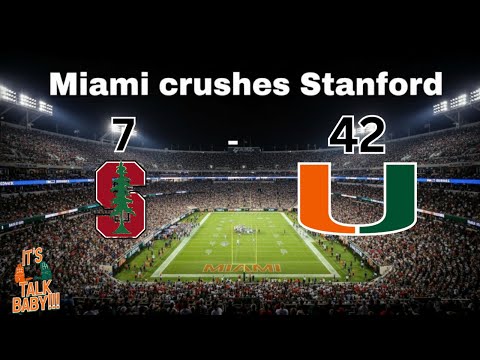
Here’s the thing about blowouts: they’re the best liar in sports. A final score of 42-7 goes into the record book, gets screenshotted, gets posted with three flame emojis, and by Tuesday nobody remembers that this same football team spent thirty minutes of the 2025 season deadlocked 7-7 with the worst outfit in the ACC. The scoreboard doesn’t have a memory. We do.
Second-Half Miami Is Not a Team. It’s a Rescue.
Let’s be precise about what happened against Stanford, because precision is the only thing that helps here. Miami did not dominate a bad team. Miami tied a bad team for two quarters and then, at some point after the break, remembered it was carrying five stars in its back pocket and turned a competitive game into a laugher. Those are two completely different football games sharing one box score, and only one of them tells you anything about who this team is.
The optimistic read is “they made adjustments.” I want to believe that. I really do. But adjustments are a repeatable process, and what Miami keeps producing looks less like a process and more like a rescue — the moment where superior athletes finally stop cooperating with a game plan that isn’t giving them any help and just go win it on raw ability. That’s not coaching. That’s recruiting cashing a check that coaching wrote.
And here’s the uncomfortable part: a rescue only works when there’s enough talent gap to rescue you. Against Stanford, that gap is a canyon. You can be schematically stubborn for thirty minutes and still win by five touchdowns, because the floor of your roster is higher than the ceiling of theirs. The math stops working the second the opponent’s floor rises.
The First Half Is the Scouting Report Everyone Else Is Reading
Understand how the rest of the league is watching this tape. No opposing coordinator is queuing up the fourth quarter of a 42-7 game. Nobody’s studying garbage time. They’re studying the first thirty minutes — because that’s the film where Miami’s actual operating system is visible, unhidden by talent, running at full stubbornness.
And what does that film show? A run game that keeps hammering the same interior gaps whether or not the defense has stacked the box to invite it. Zero pre-snap answer when a defense declares its intentions. A staff that will identify a concept that works — a quick perimeter throw that moves the chains on a short-yardage down — and then bury it like it was a one-time coupon. Personnel groupings that telegraph before the ball’s even snapped.
That’s not a mystery to solve. It’s a menu. You hand a competent coordinator two quarters of that and he’s not going to spend the week guessing. He’s going to spend the week building the exact defense that makes Miami play left-handed, and he’s going to do it knowing that Miami’s counter-punch historically arrives around the 25-minute mark of the second half — which is far too late when the talent gap is a foot instead of a mile.
Talent Is a Battery, Not a Generator
This is the framing I keep coming back to. Miami has spent years stacking elite recruiting classes. That’s real. That’s an asset. But a roster’s talent advantage is a battery — a finite charge you draw down when your scheme isn’t producing free yards on its own. Every week you win on athletes alone is a week you drained the battery instead of building a generator.
Against the bottom of the ACC, the battery covers everything. It covers a slow start, a predictable call sheet, a lineman getting stood up by a nose tackle he should be moving. It covers all of it, and the final score looks like a masterpiece. But you cannot plug a battery into November and expect it to power a playoff run against a staff that game-plans, adjusts at halftime, and has its own five-stars.
The generator is scheme. It’s the stuff that produces yards you didn’t earn athletically — the motion that creates a numbers advantage, the formation that forces a defense to declare, the counter to the counter. Right now, honest evaluation says Miami is running mostly on battery, and the 2025 season is heading toward the exact stretch of schedule where that gets audited.
The Depth Question Nobody Wants to Answer Out Loud
Here’s the second-order problem that a 42-7 win should have solved and didn’t: what exactly are we doing with the roster we recruited?
If you build top-ten classes year over year, a five-touchdown lead over a struggling opponent is the single most valuable resource in your season. It’s free reps. It’s the only laboratory that exists in college football — live bullets, real speed, zero consequence. That’s where you find out whether the young guy you signed can actually play, whether the depth behind your starter is functional or theoretical, whether you’d survive an injury in a game that matters.
When those reps only materialize after fans have spent a week complaining online, that’s not a development philosophy. That’s public-relations substitution. And it raises a question that should genuinely haunt a program with Miami’s recruiting profile: what does “development” mean if it never gets tested? A player who has been in the building for two years and has never taken a meaningful snap has not been developed. He has been stored.
Complaining Isn’t Hating. It’s Literacy.
There’s a reflex in Canes world — and honestly in every fan base with scar tissue — to treat criticism after a win as ingratitude. “We won by 35, what do you want?” I want the thing that’s actually predictive.
Having an opinion is not bitching. Winning big doesn’t retroactively make four straight weeks of the same rotation, the same call sheet, the same slow start disappear. The score is an outcome. The process is the leading indicator. Anybody who’s watched this program for more than one cycle knows exactly how this movie goes: you paper over the process because the outcomes are good, and then the outcomes stop being good and everybody acts shocked, even though the process was screaming the whole time.
Winning is the point. Nobody’s arguing otherwise. But you can hold two things: this team is talented enough to blow the doors off bad opponents, AND this team has structural issues that a bad opponent cannot expose. Those aren’t contradictions. They’re the same sentence viewed from both ends.
What I’m Watching For
Forget the final score next week. Here’s the actual scorecard:
Does Miami score on its opening two drives, or is there another dead half? Does anything change pre-snap when the defense loads the box, or do we run into it anyway? Does a concept that works get used more than once? Does anybody who isn’t a starter see the field before the outcome is decided?
Answer those four questions and you’ll know what this team is in the 2025 season, no matter what the numbers on the graphic say. Because 42-7 tells you Miami is more talented than Stanford, which — respectfully — we already knew in August. It doesn’t tell you whether Miami is well-coached. And that’s the only variable left that matters.
The battery’s still got charge. The schedule is about to find out if anybody built a generator.
One More Thing
This take grew out of this week’s U Talk episode, where Devin, Larry Frank Jr. and AO went deep on the tape after the Stanford win and refused to let the final score do the talking for them. Go listen to the full breakdown — the film-room stuff and the caller phone lines are worth your time.
This take grew out of the October 27, 2025 episode — watch it here: Recap Show Standford 7 -42 Miami U TALK LIVE-275