
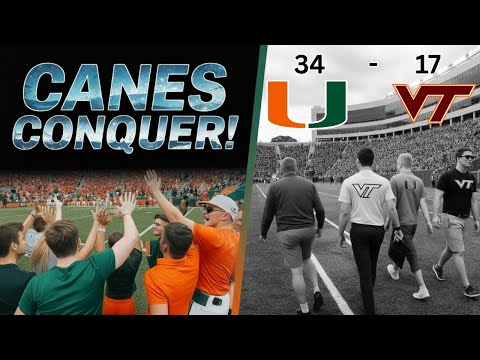
Let’s start with the only sentence that matters heading into the last week of November in the 2025 season: Miami beat Virginia Tech 34-17, never trailed, and woke up Sunday morning to a national graphic telling the country the Hurricanes had “survived a scare.” Two scores. Wire to wire. A scare.
Now let’s talk about what that actually is, because “media bias” is too lazy a phrase for what’s happening here. This isn’t bias. Bias is a guy on a set who likes one team more than another. What Miami is dealing with is a tax — a structural, week-over-week surcharge applied to every result the program produces. Other teams win by 17 and bank a win. Miami wins by 17 and has to pay the toll before the win clears.
The tax has a rate, and the rate is “style points”
Here’s how the tax gets collected. It doesn’t come as an accusation. It comes as a question. “Is this the same Miami team we saw earlier?” “Do the Canes have enough juice to hang with the big boys?” “Where were the style points today?” Nobody has to say Miami is bad. They just have to make sure the win never gets to sit there uncontested.
And notice the beautiful part of the con: style points are undefined on purpose. There is no number. There’s no threshold where a program gets told, congratulations, you cleared it. If Miami wins by 17, they needed 24. If they win by 24, the opponent was bad. If they win by 40, the schedule was soft. The goalposts aren’t moving because somebody’s careless — they’re on wheels by design. A metric with no definition can never be satisfied, which means the tax never expires.
Compare that to the vocabulary the sport keeps in the other drawer. When a blue blood grinds out an ugly one, the language is warm: gritty, physical, they found a way, that’s what November football looks like. Same box score, different logo, entirely different adjective. That’s the whole trick. Utah gives up a mountain of rushing yards and it’s toughness. Miami gives up chunks and it’s a red flag about the identity of the program. Nobody has to lie. They just have to choose the noun.
Why the tax exists in the first place
This part matters more than the complaining, so stay with me. The style-points tax on Miami isn’t random. It’s a hedge.
The people building the national conversation made a bet a long time ago about which brands drive the sport’s revenue. That bet is priced into every ranking conversation, every Sunday panel, every graphic. When Miami plays well, that bet is threatened — because a resurgent Miami reshuffles who gets the big windows, who gets the noon-versus-primetime slot, whose merchandise moves, whose alumni base is loud in December. So the hedge is simple: never let a Miami win become a settled fact. Keep every result provisional. That way, if the Canes fade, you were right all along; and if they don’t, you can pivot late and act like you saw it coming.
That’s not a conspiracy theory, that’s just how institutions protect their previous investments. And it explains something that pure “they hate us” framing can’t — why the tax gets heavier when Miami is good. A 6-6 Miami gets ignored. A Miami that’s in the playoff conversation gets audited.
The officiating version of the same tax
You see a cousin of this in how the flags fall. Watch when the calls come against Miami — in the moments that decide drives, in the first three quarters, in the leverage downs. Then watch when the balancing calls arrive: late, in garbage time, when the outcome is already decided but the penalty column still needs to look symmetrical for anyone who checks the box score on Monday.
I’m not telling you a room full of people scripted that. I’m telling you that a top-ten defensive line drawing essentially nothing in the way of holding calls, week after week, is a pattern — and patterns are what you’re allowed to notice. When the tape says one thing every single Saturday and the stat sheet says something else, the stat sheet is the thing being managed.
How you actually beat a tax
Here’s my real argument, and it’s not “complain louder.” You cannot argue your way out of a tax with no defined rate. You can only get to a place where the tax can’t reach you.
For Miami in the 2025 season, that place is the ACC Championship Game. Not the rankings. Not the Sunday show consensus. The bracket. A conference title is the one asset in this sport that no panel can talk you out of — it doesn’t require anybody’s permission, it doesn’t need style points, and it doesn’t care what adjective got used on the broadcast. It’s a fact with a trophy attached.
That’s why the path talk isn’t just scoreboard-watching trivia. It’s the exit ramp off the whole rigged conversation. Beat Pitt. Get the help you need from the rest of the league. Then go win the thing on the field where no graphic gets a vote. Every hour Miami fans spend litigating a ranking is an hour that doesn’t move the needle; every result that stacks toward Charlotte does.
The Notre Dame problem, stated plainly
And look — the head-to-head thing is the cleanest illustration of the tax there is. Miami owns the result against Notre Dame. Owns it. Yet the argument keeps getting relocated to terrain where the result doesn’t count: schedule strength, eye test, vibes, “who’d you rather.” Run the Irish slate and look at who’s actually on it — the wins over teams sitting near the bottom of their own conferences don’t magically become quality because of who’s wearing the gold helmets.
Which brings us back to the definition problem. If head-to-head matters, say it matters and apply it. If it doesn’t, say that, and apply that to everybody. What we get instead is a standard that appears when it’s convenient and vanishes when it isn’t — the same undefined-metric trick as style points, just wearing a different jacket.
So what do we do with it
Two things, and they’re not contradictory. First: keep the receipts. Write down the language, the timing, the flags, the graphics. Not because a scoreboard operator in Bristol is going to read your notes and apologize, but because a documented pattern is the only thing that eventually forces a standard to get defined. Fan bases that stop keeping receipts get rewritten.
Second: don’t let the tax become the identity. The worst thing that can happen to a fan base fighting a narrative is that fighting the narrative becomes the whole hobby — where the wins stop being fun because you’re already bracing for Sunday’s graphic. Miami beat Virginia Tech 34-17 and never trailed. That was a good football Saturday. Enjoy the good football Saturday. Then go get the next one.
Because here’s the thing about a tax with no defined rate: the only way it ever stops is when the thing being taxed gets too big to assess. Win the league, and the bill stops coming.
This take grew out of this week’s episode, where Larry Frank Jr. and AO went deep on the “survives a scare” graphic, the officiating pattern, and the exact math of the ACC path — plus callers who came with receipts of their own. Go listen to the whole thing.
This take grew out of the November 24, 2025 episode — watch it here: Recap Show Miami 34 – 17 U TALK LIVE-282