
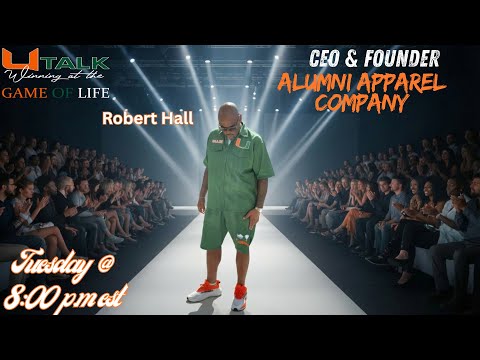
Every program in the country has a merch table. Miami has something else entirely, and if you want to understand what makes the U different in the winter of 2025, don’t start with the depth chart. Start with what Edgerrin James was wearing on the sideline.
Because here’s the thing about this place that outsiders never quite get: Miami’s alumni network isn’t a mailing list. It’s a living, breathing, group-chat-having, sideline-crashing organism. And when Robert Hall — Polo Rob to anybody who’s been around — decided to put a jersey on it, he didn’t invent demand. He answered a question his own teammates were already asking him.
The Product Nobody Was Making
Think about how strange it is that this gap existed at all. For decades, if you were a former Hurricane and you wanted to represent — not in a stadium giveaway tee, not in a licensed replica of the jersey you actually wore, but in something that said I am part of this thing forever — your options were thin. You could dig into a closet. You could commission something one-off. Or you could go without.
That’s the void Hall walked into. Alumni Apparel didn’t start as a Miami play at all; it started as fly merch for North Shore, the Houston high school powerhouse that turns out talent like a factory line. Local pride, done right. But the Miami guys saw it, and the ask came back immediately: why don’t you do something for us?
The answer arrived at Edgerrin James’ Hall of Fame weekend in 2021, when thirty former Canes showed up wearing Hall’s jerseys on national television. Thirty. Not a sponsorship. Not a licensing deal with a logo on a shipping box. Thirty grown men who played this game at the highest level, choosing the same piece of clothing on the same weekend because one of their own made it and made it right.
Why the Stitching Matters More Than You Think
Here’s where I want to get specific, because the details are the whole argument. Fully stitched jerseys. Embroidered work, not heat press. Letterman-style backs. Zipper pockets on every pair of shorts. And — this one’s underrated — no upcharge for big sizes.
That last one is a philosophy disguised as a pricing decision. Think about who’s actually buying alumni gear from a football program. A meaningful chunk of your customer base is former offensive linemen, former defensive tackles, grown men who spent their twenties being professionally enormous and never shrank all the way back. The entire apparel industry has spent decades treating those customers as a surcharge opportunity. Hall looked at the same customer and saw a teammate.
You cannot buy that instinct with a marketing budget. It comes from having been in the room. And it’s precisely why the thing spread the way it did — because when a former player picks up a garment and finds it built like it was made by somebody who knows what a locker room actually is, that’s a referral engine no ad spend replicates.
The Andre Johnson and Edgerrin James sightings weren’t a campaign. They were two Hall of Famers wearing something they liked, including together at the season-opening Notre Dame game, in front of a national audience that couldn’t help but ask: what is that, and where do I get one?
The Ghost in the Room: Miami Was Here Before
What elevates this from a nice small-business story to something genuinely important is the history sitting right behind it — history most Canes fans have never heard.
Melvin Bratton, in the early nineties, ran a college-throwback apparel company alongside Rueben Bain’s uncle. And what they built was, in hindsight, staggering. They signed Deion Sanders. They signed Warren Moon. They signed Bernie Kosar. And they structured those deals on a sliding royalty scale — athletes taking a cut of what their own name and image generated.
Read that again with 2025 eyes. That is name, image and likeness. That is the entire architecture of modern college athlete compensation, sketched out by Miami people roughly three decades before the NCAA was dragged into it. The College Licensing Committee was reportedly stunned by what they’d assembled. Macy’s test markets sold out. The model worked.
And then it died — not to a lawsuit, not to a competitor, but to a Jay-Z lyric that turned the throwback era off like a light switch. One line in one song, and a whole category evaporated.
There’s a lesson buried in that, and it’s not a comfortable one: being early is not the same as being rewarded for it. Bratton’s group was right about where the industry was headed and got nothing for the accuracy. The culture giveth and the culture taketh away, and no business plan survives contact with a bar that lands.
Which is exactly why what Hall is building now hits differently. He’s not dependent on a trend cycle. He’s dependent on whether people still love the U — and that is the single safest bet in American college sports.
The Unglamorous Part
Now, the part that should be required reading for every young athlete who thinks the brand comes first and the work comes later.
Alumni Apparel is a one-man operation. Hall designs it. Hall orders it. Hall ships it. Hall answers the customer service messages. And on Fridays he’s flying to Houston to keep the North Shore side of the business alive. Hall of Famers are wearing his product on national broadcasts and the CEO is packing boxes.
That’s not a charming quirk. That’s the entire model, and it’s one he learned at home. His parents ran the side-hustle-plus-day-job playbook, and Hall has run it his whole adult life. A hair salon and a hair store — until the pandemic closed them, which he’ll tell you was his biggest loss. A roofing and construction company he operated with his mother, rebuilding homes in New Orleans after Katrina. Real work, in a real disaster zone, with his mom as a business partner.
So when the apparel thing finally caught fire, it wasn’t a lottery ticket. It was somebody’s fourth or fifth swing, taken by a man who had already learned how to lose a business and keep going.
What This Should Tell the Program
Here’s my broader take, and I’ll own it: Miami has consistently underestimated the commercial and cultural power of its own alumni network, and the people filling that gap keep being the alumni themselves.
Every school talks about brotherhood. Very few have a brotherhood that will independently organize, buy the same jersey, and wear it on television without anybody coordinating it. That’s an asset. That’s a moat. In an era where every program is scrambling to build a collective, a media arm, and a merchandise pipeline, Miami has something more valuable and less replicable — a diaspora of former players who genuinely want to be seen together.
Hall didn’t build the network. He just built the uniform for it. And for the record, he’s got a show code running: UTALK20 for 20 percent off everything at alumniapparel dot com through January 1.
The jersey is the business card. Miami just needed one of its own to print it.
This take grew out of this week’s Winning at the Game of Life conversation with Robert Hall on U Talk, where Melvin Bratton dropped by and unloaded the throwback story that’s been sitting in Miami’s pocket for thirty years.
This take grew out of the December 10, 2025 episode — watch it here: CEO of Alumni Apparel Company Robert Hall U TALK Winning at the Game of Life Episode-23