
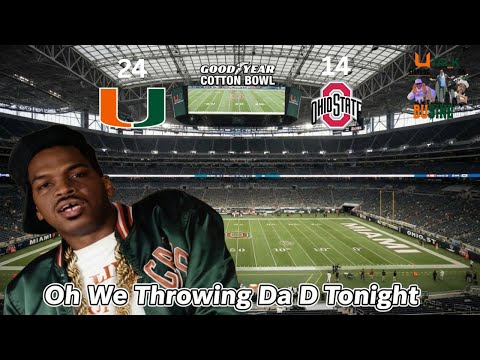
There’s a specific kind of Miami fan who has been holding their breath since January 3, 2003. You know the one. The guy who can’t hear the words “Ohio State” on a broadcast without changing the channel. The guy who has a whole speech ready about the flag. The guy who’s been carrying 23 years of it around like a rock in his pocket, taking it out and looking at it every so often just to make sure it still hurts.
On New Year’s Eve, that guy exhaled.
Miami 24, Ohio State 14. Cotton Bowl. Defending national champions, sent home. And here’s the part that matters more than the catharsis: this wasn’t a fluke, a fat-cat bowl game where the favorite showed up flat and the underdog caught lightning. This was Miami physically taking a game from the team that everybody in America spent the entire 2025 season telling us was built different in the trenches.
The Revenge Narrative Is the Least Interesting Thing About This Game
Let me say the unpopular thing on a hub built for Canes fans: the 2002 title game had nothing to do with this. Not one player on either roster was alive for it in any meaningful way. Ryan Day wasn’t there. Larry Coker wasn’t there. The pass interference flag that lives rent-free in every Miami household is a piece of folklore now, not a scouting report.
And that’s exactly why beating Ohio State this way is bigger than revenge. Revenge is a closed loop — you get it, you feel it for a night, and then the sun comes up and you’re the same program you were. What happened in Dallas was something else. It was a resume line. It was proof of concept.
For a decade and a half, the knock on Miami was never talent. South Florida keeps producing. The knock was that Miami couldn’t beat a real, structurally sound, blue-blood football program in a game where both sides were prepared, healthy, and had two weeks to game plan. That’s the specific failure mode. Miami could out-athlete you in September. Miami could not out-execute you in January.
The Cotton Bowl is the counterexample. Two weeks of prep, a defending champion, a national stage, and Miami won the part of the game that isn’t about athleticism at all.
Five Sacks Against the Team That Was Supposed to Own the Line of Scrimmage
Five sacks. Read that again and then think about who it came against.
Ohio State’s offensive line was a talking point all year — the kind of unit that gets a segment on every pregame show, that gets described with words like “NFL-ready” and “the reason they’re the favorite.” Miami’s defensive front took that reputation and left it in the visitors’ locker room in Arlington.
Rueben Bain Jr. and Akheem Mesidor were unblockable early, and that word — early — is the whole ballgame. Sacks in the fourth quarter of a blowout are stat padding. Sacks in the first quarter, when the game plan is still intact and the quarterback still trusts his protection, are architecture. They change what a coordinator is willing to call. They shrink the playbook. By the time Ohio State knew what it wanted to do, Miami had already taken half of it away.
This is what a real defensive line does. Not “gets pressure.” Not “disrupts.” It makes the other team’s offense smaller. That’s a skill Miami has claimed for years and delivered on intermittently. On New Year’s Eve, against the best possible opponent to prove it on, the line delivered.
Carson Beck and the Death of a Narrative
There is no player in college football who has been more aggressively defined by a single word than Carson Beck. Interceptions. That’s it. That’s the whole national conversation about a quarterback who has been productive at two elite programs.
Beck played mistake-free football in the biggest game of his career. He was poised. He used his legs — which is the underrated part, because a quarterback who can extend a drive with eight yards on third-and-six is a quarterback who forces a defense to stay honest for sixty minutes. And he did it without the one thing everyone was waiting for.
Here’s what I want Canes fans to sit with: a quarterback who protects the football is worth more in a four-team-deep playoff bracket than a quarterback who makes three highlight throws and one catastrophic one. Miami didn’t need Beck to be a hero in Dallas. Miami needed Beck to not be a villain. He wasn’t. That’s a win condition, and it’s the win condition that travels into a semifinal.
The Jeremiah Smith Thing Is Funnier Than You Think
Smith said he’d have signed with Miami if Miami had been winning. Fine. Recruits say things. But there’s a genuine lesson buried under the trash talk, and it’s not about one player.
South Florida talent has been leaving South Florida for twenty years on exactly that logic — go where the winning is. That’s not disloyalty, that’s a nineteen-year-old making a rational bet on his own career. The only way you reverse it isn’t with a billboard or a speech. It’s with a scoreboard. Every time Miami beats a program that has been harvesting Dade and Broward, the math for the next kid changes a little.
Beating Ohio State in the Cotton Bowl is worth more on the recruiting trail than any pitch a coach can make in a living room. The pitch made itself, on national television, for three and a half hours.
Now the Hard Part
Thursday, January 8. Semifinal. Georgia or Ole Miss. And then, if Miami gets through, the national championship game at Hard Rock Stadium.
I want to be honest about the danger here, because a fan-first column that only tells you what you want to hear isn’t worth reading. The trap after a win like this is emotional. Miami just played its Super Bowl. Twenty-three years of accumulated grievance got resolved in one night, and the human nervous system does not simply reset for the next opponent seven days later. Ohio State was the game that meant something. Georgia is just the game that’s next.
That’s the exact psychology that has ended a hundred great seasons. The upset is never the hard part. The week after the upset is the hard part.
But here’s the case for optimism, and it’s a real one: what Miami did in Dallas wasn’t emotional. Five sacks isn’t emotion. A quarterback not turning it over isn’t emotion. Jumping out 14-0, absorbing the third-quarter haymaker that everyone in the building knew was coming, and then closing it out late — that’s not a team riding a feeling. That’s a team executing a plan against elite competition and having the plan hold up.
Emotion doesn’t survive a week. Structure does.
And structure is exactly what Miami has been accused of lacking for twenty years. If the 2025 Canes have finally got it — if this is a team and not a mood — then the championship game at Hard Rock isn’t a fantasy. It’s a Thursday away.
The old rock in the pocket is gone. Time to find out what’s worth putting there instead.
This take grew out of this week’s instant-reaction episode of U TALK LIVE, where Devin and Larry Frank Jr. threw open the doors for an impromptu Cotton Bowl celebration that nobody had planned and everybody needed.
This take grew out of the January 1, 2026 episode — watch it here: Instant Cotton Bowl Reaction Miami vs Ohio St. U TALK LIVE-289