
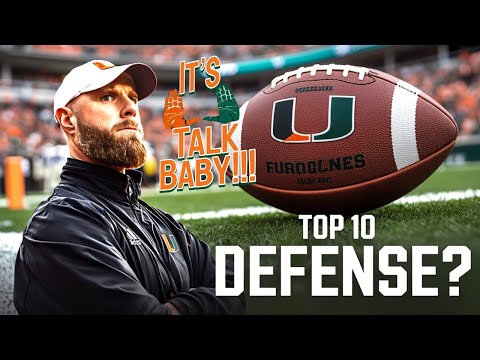
Let’s put the question the whole fan base is asking on the table and then let’s take it apart, because the framing is wrong. Everybody in Coral Gables wants to know whether Corey Hetherman can take the 27th-ranked defense he inherited and drag it into the top ten. That’s the number that gets tossed around at every cookout from Homestead to Hollywood right now, one month out from football, and it’s the number that’s going to be on the graphic every time somebody debates this thing between now and kickoff of the 2025 season.
Here’s the thing though: top ten is a scoreboard for the offseason. It is not the thing that cost Miami last year. Miami didn’t miss the playoff because it finished 27th. Miami missed the playoff because a defense ranked 27th could not get a stop when the game asked it to, and there is a real difference between those two sentences.
A ranking is a season-long average. Losses happen in eight-minute windows.
Rankings are cumulative. They smooth. They take a defense that got obliterated in one drive-for-drive stretch and average it against three quarters where the other team was already trailing by three scores and throwing it up for grabs. A unit can sit at 27th and still be genuinely fine for long stretches — and a unit can sit at 27th because it was competent for fifty minutes and catastrophic for ten. Miami’s was the second kind. That’s why the record ended up being what a lot of us called an ugly 10-2. Ten wins with an offense that was doing the heavy lifting on every single one of them.
So the actual bar for Hetherman in year one is not a ranking. The bar is: when Miami has a lead in the fourth quarter and the other team needs a touchdown, does Miami’s defense make them earn it? That’s a binary question. It’s yes or no. And it doesn’t require this unit to become the 2001 defense to answer yes.
Think about it in terms of the games. You don’t need to be top ten to close out a divisional opponent on the road. You need three stops in a two-possession game. Three. That’s the entire margin between the season Miami had and the season Miami wanted.
The tell isn’t the stat sheet — it’s whether the same mistake happens twice
Here’s the diagnostic I’d use, and it’s the one I trust more than any number that gets published on a Sunday night. Forget the rankings entirely for the first month. Watch angles and watch tackling. Not whether they’re perfect in September — nobody’s perfect in September — but whether a bad angle in the first quarter is still a bad angle in the third quarter.
That was the sickness. Not that Miami missed tackles, because everybody misses tackles. It was that the same missed fit repeated series after series, quarter after quarter, with no visible correction in between. That’s not a talent problem. Talent problems look different — talent problems look like a guy getting beat because the other guy is faster. Repetition of the identical error inside one football game is a coaching and communication problem, and it’s the single most fixable thing on the entire depth chart.
So the first real Hetherman checkpoint isn’t Notre Dame. It’s the first time in any game this fall that a running back breaks the same run twice and the second one gets swallowed. If that happens, you can stop worrying about the ranking, because that’s the whole thing. That’s the fix.
The in-game adjustment is the whole job
Which brings us to the part nobody wants to say plainly. The gap between the last staff and this one has to show up when Hetherman’s back hits the wall. Anybody can call a good first-quarter script. You have all week to write it. The job is what you call on the sideline when the opponent has found something and your original plan is dead and there are eleven minutes left.
That’s the thing that was missing. That’s the thing that turned a good roster into an average defense. And it is also, to be fair to Hetherman, the thing you cannot possibly evaluate in June. You can’t scout it out of a spring practice. You can’t read it in a press conference. You have to see him do it against a real opponent with real stakes, and until then anyone telling you they know the answer is guessing.
I can do it, but I got to see it. That’s the honest position and I’ll stand on it.
The blueprint already exists, and it isn’t the one you’d expect
Here’s what should actually give you hope, and it’s not a recruiting ranking. Look back at 2017. That defense didn’t have a roster full of All-American names. It had lunch-pail dogs with football IQ who were where they were supposed to be, and it produced the kind of moment that defines an era — Trajan Bandy reading the quarterback’s eyes for the pick-six against Notre Dame. That’s not a five-star athletic play. That’s a guy who understood the concept, understood the down, and understood what the quarterback was looking at.
You can’t recruit that in six months. But you can teach it. Scheme plus fundamentals beat star ratings, and it has happened in this exact building, in front of these exact fans, in living memory.
That’s the version of a Hetherman turnaround that’s actually realistic in year one. Not a top ten unit built on freak athletes. A unit that lines up correctly, tackles the guy the first time, and doesn’t repeat itself.
The healthy skepticism you should hold onto
Now, the counterweight, because this column isn’t a commercial. New coordinators tend to look great in year one. That’s not a knock on anybody, it’s just how the sport works — the league hasn’t seen your wrinkles yet, the tape doesn’t exist, opposing staffs are guessing. Manny Diaz’s first year here is the obvious case study. The question is never year one. The question is what happens when the conference has twelve games of film on you.
So temper the ceiling talk. If Hetherman gets this to a solid, disciplined, adjust-in-real-time defense in 2025, that’s a massive win and it probably means a very different November than the one we just lived through. Whether it holds up in year two is a completely separate conversation and it’s not one we get to have yet.
What it’s actually worth
Understand the stakes here. Six of last year’s playoff teams had top ten defenses. That’s not a coincidence and it’s not a talking point — that’s the entry fee. But Miami doesn’t need to buy the deluxe package. Miami needs a defense that’s merely good enough to not actively cost the offense games, and with a comparable unit behind the offense this program has been putting on the field, you’re looking at a deep run. Not a nice season. A run.
That’s the math that makes this the biggest question of the offseason. The margin between where this defense is and where it needs to be is smaller than the ranking makes it look. Twenty-seventh sounds like a rebuild. Three fourth-quarter stops sounds like a fix.
Notre Dame will tell us something. Florida will tell us more. Louisville and the ACC grind will tell us everything. Until then, watch the angles.
This take grew out of this week’s episode of U TALK LIVE, where the family spent the night going back and forth on exactly this question — and nobody in the room fully agreed on the answer.
This take grew out of the June 7, 2025 episode — watch it here: “Can Corey Hetherman take a 27th ranked D and make it top 10 ?” Miami Hurricanes U TALK LIVE-254