
Every dynasty gets flattened by time. Twenty, thirty years out, the seasons stop being seasons and start being posters. You remember the swagger, the Sports Illustrated covers, the fact that Miami won it all — and somewhere in the compression, the part where it was genuinely hard just falls out of the story. That’s the tax nostalgia charges. You get the trophy, you lose the process.
So when Jimmy Johnson gets asked about that second national championship at The U and the first word out of his mouth is essentially struggles — that’s worth stopping on. Not because it’s a scandal. Because it’s the opposite of how we’ve been taught to talk about that program.
“We really wasn’t running my style of defense”
Sit with that sentence for a second. That’s the head coach of a national championship team at the University of Miami saying that the defense on the field was not, in a fundamental sense, his defense yet. Not a scheme tweak. Not a wrinkle. Style. Identity. The thing a Jimmy Johnson defense is famous for being — fast, undersized by conventional standards, attacking, built to make the offense play left-handed — was still under construction while the wins were piling up.
That is a wildly different picture than the one most fans carry around. The mental image is Johnson arriving in Coral Gables and immediately unleashing a swarm of track guys in shoulder pads on a college football world that wasn’t ready. Clean. Cinematic. Wrong, apparently, or at least incomplete. What he’s describing is messier and honestly more impressive: winning at the highest level while converting the roster and the philosophy underneath you, in real time, with the season already rolling.
Anyone who has ever tried to change something big while it’s still running knows what that costs. You can’t stop the machine. There’s no offseason inside a season. Every Saturday still comes with a scoreboard, and the scoreboard does not care that you’re mid-installation. Johnson’s admission is that Miami’s second title wasn’t the reward for a finished product. It was won by a team still becoming the thing that would later terrify the sport.
Why This Reframes the Whole Dynasty
Here’s the part that should actually rewire how you talk about Miami football at cookouts: if the second championship was won with a defense that wasn’t yet fully Johnson’s, then the ceiling that came after wasn’t luck. It was compounding.
Most programs win a title and immediately start defending it — protecting the formula, freezing the identity, hoping the magic holds. Johnson’s telling of it suggests the opposite instinct. He won and kept renovating. He looked at a championship defense and saw the parts of it that were still somebody else’s idea. That’s a specific kind of restless that separates the coaches who catch lightning from the coaches who build a power plant.
And it explains the run that followed. When a program’s identity finally locks in after it’s already proven it can win the whole thing, you don’t get one great year. You get a decade where everybody else is playing catch-up to a standard that was set by a team that hadn’t even finished becoming itself.
The Roster Math Nobody Puts on a Poster
Think about what “changing the style of a defense” actually means in practice, because it isn’t a whiteboard exercise. It means you have players on scholarship who were recruited to do a job that no longer exists. It means guys who were assets in the old system become square pegs in the new one — through no fault of their own. It means asking veterans, some of them very good players, to learn a different game in the middle of a title chase.
And you have to do all of that without breaking the locker room. That’s the piece that gets lost. Scheme change is a personnel problem and a people problem before it’s ever a football problem. Every one of those conversations is a chance for a team to fracture. Miami didn’t fracture. Miami won a national championship in the middle of it.
That’s the story that never makes the documentary, because it doesn’t cut well. There’s no b-roll of a coach convincing a linebacker that the new alignment is worth it. But that’s the actual work, and it’s the reason Johnson’s answer starts where it starts.
What Today’s Canes Fan Should Take From It
Now, September 2025, and Miami fans have spent a long time in a very particular kind of purgatory — the one where every promising stretch gets measured against ghosts. The problem with worshipping the ghosts is that we mythologize the outcome and skip the mechanism. We remember that The U was dominant. We forget that dominance was assembled out of ugly weeks, hard conversations, and a coach willing to say a championship-caliber unit still wasn’t good enough to be his.
The lesson isn’t nostalgic. It’s operational. Great programs are not the ones that avoid struggle; they’re the ones that keep making themselves uncomfortable after they’ve already won something. If a team is playing well and the coach still says out loud that the identity isn’t where it needs to be, that isn’t a red flag. Historically, at this school, that has been the tell.
So the next time somebody tells you the golden era was just superior talent showing up and turning it on — you’ve got the counter-argument straight from the man who ran it. Yes, the talent was absurd. But the talent was being redirected, in-season, toward a philosophy that hadn’t fully landed yet. Titles came anyway. Then the philosophy landed, and the sport had a problem for years.
Honesty Is the Rarest Thing in Legacy Talk
The last thing worth saying: coaches with Johnson’s résumé have every incentive to keep the story clean. Nobody would blink if he answered a question about a national championship by talking about how special that group was and moving on. The polished version is available to him at all times.
He didn’t take it. He led with the struggles. He named the specific thing that wasn’t right. That kind of candor from someone who has nothing left to prove is how you can tell the memory is real and not rehearsed — and it’s a hundred times more useful to a fan base trying to understand what winning actually requires.
Miami’s second title wasn’t the finished cathedral. It was the scaffolding, and it still beat everybody. Sit with that one for a while.
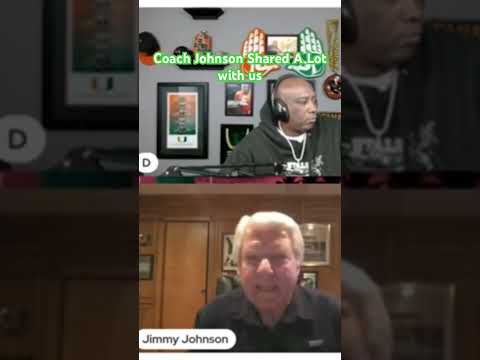
This take grew out of this week’s U Talk Sports Show sit-down with Coach Jimmy Johnson, where co-host Larry Frank Jr. asked about that second national championship and got a far more honest answer than the question required. Worth your time.
This take grew out of the August 30, 2025 episode — watch it here: Coach Jimmy Johnson shared a lot with us! Shout out to my Brother and Super Co-Host Larry Frank Jr.