
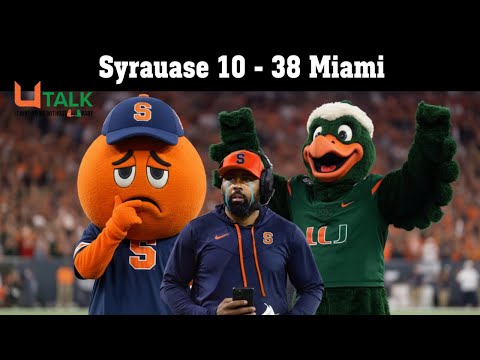
Let’s get one thing straight before the comment section catches fire: 38-10 is a good football score. Any Canes fan who lived through the 2010s will tell you that beating an ACC team by four touchdowns used to be the kind of thing that got a program a parade down Coral Way. So no, this isn’t a column telling you the win doesn’t count. It counts. Put it in the bank.
But here’s the thing that’s been rattling around my head since Saturday night in the 2025 season, and it’s got nothing to do with Syracuse: Miami keeps playing two completely different football teams inside the same helmet, and nobody on that sideline seems to have any control over which one shows up in the first quarter.
The Twenty-Seven-Minute Problem Isn’t A Vibes Problem. It’s A Process Problem.
Twenty-seven minutes. That’s how long this offense sat on zero against a three-win football team. And I don’t want to hear “they were feeling it out” or “it’s a long game.” You know what a long game is? A game you have to come back and win because you spent the first half doing calisthenics.
What bothers me isn’t the slow start in isolation. It’s that this is now a documented, repeatable, reliable feature of Miami football. Stanford. Louisville. SMU. Now Syracuse. When something happens four times, it stops being variance and starts being identity. That’s not bad luck. That’s a script problem. That’s a preparation problem. That’s somebody in the building deciding, week after week, that the opening drives are a scouting exercise rather than a scoring opportunity.
Great offenses script. They walk in with the first fifteen plays already decided, already practiced, already designed to attack a specific thing they saw on tape. You come out swinging because the defense has never seen your looks live and that’s your single biggest information advantage of the entire night. You burn it early or you lose it forever.
Miami keeps choosing to lose it forever. And then at some point in the third quarter, when the game state finally gets uncomfortable enough, the playsheet mysteriously develops a personality.
The Trick Plays Are The Tell — And Not For The Reason Everybody’s Saying
Everybody’s mad about the trickery. Toney throwing a touchdown to Beck. Mauigoa — a big man getting in the end zone, which is genuinely one of the great joys in all of sports and I refuse to apologize for enjoying it. The complaint you’ve heard all week is: where was this in October? Where was this when the season was still alive?
Fair. But I want to push on it from a different direction, because I don’t think the problem is that Miami ran those plays too late. I think the problem is what those plays reveal about how this staff thinks about creativity.
Trick plays in a 31-point game are a reward. They’re dessert. They’re what you call when the outcome is decided and you want to give a guy a moment. That’s the mentality — creativity as a treat, deployed when it’s safe, when nothing’s on the line, when a failure costs you nothing.
But that’s precisely backwards. Creativity isn’t a reward for winning. Creativity is a tool for winning. The Toney pass isn’t fun because it’s a gimmick; it’s dangerous because it’s an entirely different threat the defense has to account for on every single snap for the rest of the season. That’s called constraint. You put it on tape so that four weeks from now, a safety hesitates for a quarter-second on a sweep because he’s seen you throw off it.
Running it up 31 in the fourth against Syracuse spends the bullet and buys nothing. Running it in the second quarter of a one-score game against a real opponent buys you the rest of your season. Miami keeps confusing the two.
Personnel Is Being Managed Like A Depth Chart, Not Like A Roster
Here’s the piece that has me most frustrated, and it connects everything above.
When Pringle gets a carry and rips off twelve yards while the bigger backs are grinding out three at a clip, that’s not a fluke. That’s information. That’s the game telling you something about what this particular defense can and can’t handle on this particular night. And the correct response to information is adaptation — feed the thing that’s working, right now, while it’s working.
Instead you get depth-chart management. The starter starts because he’s the starter. The rotation runs because it’s the rotation. The freshmen sit until the game is decided and then get their handful of garbage-time snaps, which is the least useful possible way to develop a young player — because reps against a defense that’s already emotionally checked out teach you almost nothing about playing actual college football.
Miami is sitting on a roster stocked with talent that was recruited at an elite level, and the deployment of that talent looks like it’s being run off a laminated card made in August. Rigidity is a choice. And it’s a choice that shows up as slow starts, because a rigid plan takes a full half to discover what a flexible plan discovers on drive two.
The Committee Doesn’t Watch Film. It Watches Scoreboards At Halftime.
Now the cold math. At 3-2 in the ACC, Miami’s path exists but it isn’t in Miami’s hands anymore. You need to win out. You need Pitt. You need Georgia Tech to slip up again. And crucially, you need to look like a team worth choosing.
Understand what that last part actually means. Selection committee members are human beings with jobs and families who are watching a dozen games at once. They flip to the Miami game. It’s the middle of the second quarter and the scoreboard says zero. They flip away. Whatever happens in the next two hours — the 38 points, the explosive plays, the big-man touchdown — a meaningful chunk of the people deciding your fate never saw it. They saw a zero and formed an impression.
Style points aren’t a vanity metric. Style points are what happens when your best football is visible at the hour people are actually watching. Miami is producing genuinely impressive football that happens to be scheduled for the portion of the evening when the audience has moved on. That’s a self-inflicted wound in a year where the margin between playing in December and going home is going to be measured in exactly these impressions.
What Would Actually Convince Me
I don’t need a 60-burger. I need one game — one — where Miami’s opening drive looks like it was designed on Tuesday instead of discovered at halftime. Where the wrinkle shows up on the third snap because the coaching staff believed in it enough to risk it. Where a hot hand gets fed in the first quarter instead of the fourth.
Do that against Pitt and I’ll believe the rest of the 2025 season is real. Because the talent question was answered a long time ago — this roster can hang a 38 on people. The question that’s still open is whether anybody in that building can get this team to be itself before halftime.
Twenty-seven minutes is a long time to wait to find out who you are. And there aren’t many Saturdays left to keep waiting.
This take grew out of this week’s U TALK LIVE Sunday morning conversation, where the callers spent a whole show wrestling with why a four-touchdown win left the family more agitated than a loss would have. Go listen — Rocky, the Italian Stallion and Mr. Magic all got their licks in, and the family always brings it harder than any panel show on television.
This take grew out of the November 10, 2025 episode — watch it here: Recap Show Syracuse 10 – 38 Miami U TALK LIVE-278