
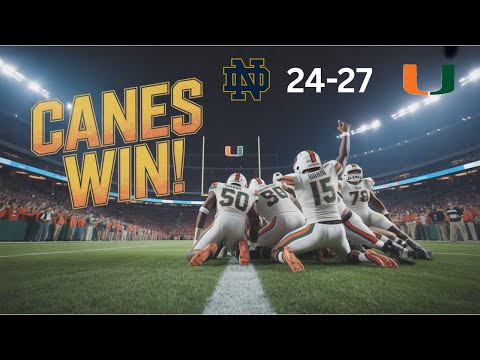
Every college football season hands out a small number of wins that do more than move a record from 0-0 to 1-0. They change the math on everything that comes after. Miami 27, Notre Dame 24 on opening weekend of the 2025 season is one of those. Not because it was pretty — it wasn’t, not for the full sixty — but because of what it deposits in the bank before the Hurricanes have played a single conference snap.
The resume win is the whole point
Here’s the thing nobody in the orange and green section wants to think about while they’re still hoarse: Miami just did the hardest thing on its schedule in Week 1. A top-six opponent, at Hard Rock, under the lights, with the entire sport watching because there was nothing else on. That’s a signature win, and signature wins are the scarcest currency in this sport.
Think about what that actually buys. In a twelve-team playoff era, committees don’t just count losses — they weigh what’s underneath them. A team that goes 10-2 with a win over a top-six Notre Dame is a fundamentally different animal than a team that goes 10-2 with nothing on the marquee. Miami now owns a chip it can cash in November when somebody inevitably gets tripped up on a Thursday night in a place where the field is bad and the crowd is worse.
That’s the real headline. Not the score. The margin for error. Miami has spent recent seasons living without any — one bad quarter, one bad half, and the season was functionally over by Halloween because there was nothing on the ledger to offset it. This team can now survive a stumble. That is new, and it matters more than any single throw from Saturday night.
The quarterback answer arrived early, and quietly
Carson Beck went 20-of-30 for 202 yards and two touchdowns. Nobody’s putting that stat line on a poster. But look at it a second time and ask what it actually tells you.
Two-thirds completion rate against a defense that good, in a first start with a new program, with the entire fanbase’s blood pressure riding on every snap. No panic. No hero ball. Two touchdowns and a win. The yardage total is modest because the game plan was modest — that’s a coaching choice, not a quarterback limitation.
What Miami needed from Beck in game one was not a Heisman audition. It was proof of concept: that he can command the huddle, that the arm plays, that he doesn’t get small when the stadium gets loud. He answered all three. The rest of the season will tell us about ceiling. Week 1 told us about floor, and the floor is high enough to win games like this one.
The trap now is the pressure to make him into something else. Every fanbase does this. The quarterback wins a big one with a clean, efficient, unspectacular game, and by Wednesday the message boards want him launching it forty yards downfield on every third down to prove a point. Resist that. The version of Beck that showed up against Notre Dame is the version that wins twelve games. Let him be that guy.
A seventeen-year-old just told you what this roster is
Malachi Toney is seventeen years old. He caught six passes for 82 yards and a touchdown in the biggest Miami home game in years.
Sit with that. Seventeen. Most seventeen-year-olds in this country spent that Saturday night at somebody’s house party stressing about a calculus test. Toney spent it running routes against a top-six defense and winning.
The stat line is fun. The implication is bigger. When a true freshman that young is not just on the field but is a load-bearing piece of the offense in a game of that magnitude, it tells you two things at once. One, the talent acquisition in Coral Gables is working — that’s a recruiting win showing up as an on-field win almost immediately. Two, this isn’t a one-year rental roster. Toney is a multi-year problem for everybody else on the schedule, and that’s the kind of foundation that turns a good season into a good era.
Pair him with CJ Daniels making circus catches before halftime and you’ve got a receiver room where the answer to “who steps up” is genuinely open-ended. Defenses have to pick a poison, and none of the options are especially appealing.
The defensive number that should scare the rest of the schedule
Thirty-three yards. That’s what Miami’s front held Jeremiah Love to — a back a lot of people in this sport will tell you is the best in the country.
Bottling up a runner of that caliber is not a scheme trick or a lucky night. That’s players winning at the point of attack, over and over, for four quarters. And it’s the single most portable thing Miami showed on Saturday, because run defense travels. It doesn’t care about weather, crowd noise, or a hostile road environment. If this front can do that to Love, it can do it to almost anybody left on the slate.
That’s the identity worth building around. A defense that erases the run forces opponents into obvious passing downs, and obvious passing downs are where Miami’s pass rushers eat. That’s a formula, not a fluke.
The fourth quarter is the tuition bill
Now the honest part. Miami got outscored 17-6 in the fourth quarter. In a three-point game. At home.
You don’t get to celebrate the win and skip that conversation. A team that closes properly wins that game by two scores and everybody goes home early. Instead Miami turned a comfortable evening into a nail-biter, and the mechanism was familiar to anyone who’s watched football for more than a decade: the offense got conservative, the defense got tired, and the opponent got exactly the daylight it needed.
Here’s the good news, though — that’s a fixable problem, and it’s better to find it in Week 1 than Week 11. This is a diagnosable, correctable, coachable failure mode, and Miami gets to correct it having already banked the win. That’s the best possible version of learning a lesson. You get the tuition bill and you still get to keep the trophy.
The question that defines the 2025 season is whether it actually gets corrected. Because a team that wins a signature game and then keeps letting fourth quarters get weird is a team that eventually loses one of these by three instead of winning it. Same game, different bounce. The Hurricanes have roughly three months to prove Saturday’s closing stretch was a first-game artifact and not a personality trait.
What to actually watch for now
Forget the polls for a minute. The tell over the next month isn’t ranking movement — it’s whether Miami plays with the same edge against opponents who don’t bring a top-six ranking into the building. Signature wins are seductive. They create a version of a team that shows up for the marquee and sleepwalks through the ordinary. Every program that’s ever collapsed in October collapsed exactly that way.
The Hurricanes have the quarterback, the freshman weapon, the receiver depth, and a front that just erased the best back in the country. The infrastructure is there. What’s unproven is the consistency — and consistency is precisely the thing Miami has been accused of lacking for the better part of twenty years.
But that’s the beautiful part about a win like this. It doesn’t answer the question. It just earns you the right to keep answering it, with a cushion, into November. Miami has that now. It didn’t have it a week ago.
This take grew out of this week’s U TALK LIVE episode breaking down the Notre Dame win, where the crew got into the good, the bad, and the ugly of Miami’s opener. Worth the listen if you want the full film-room treatment.
This take grew out of the September 2, 2025 episode — watch it here: “Miami Wins” 27-24 Notre Dame U TALK LIVE-262