
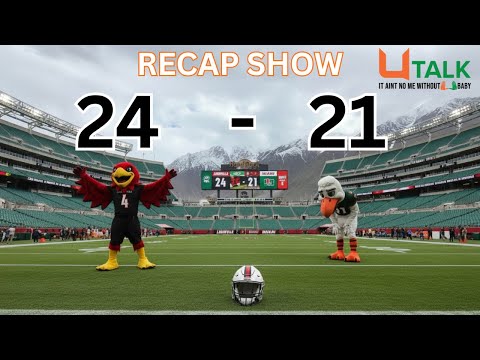
Twenty-four to twenty-one. That’s the number that ended the undefeated talk at Hard Rock, and by now everybody in the 305 has picked their villain. Some of y’all want the quarterback’s head. Some want the coordinator gone by Tuesday. Some want a receiver freed from whatever bush he’s hiding behind. Fine. Get it out. But if you want the actual reason Louisville walked into our house and walked out with a W in the 2025 season, it isn’t a person at all.
It’s a clock. A one-point-four-second clock.
The 1.4 Problem
Jeff Brohm came into Miami Gardens knowing exactly what he was walking into. He knew Rueben Bain Jr. was on that edge. He knew Akheem Mesidor was next to him. He knew that if he let his quarterback sit in the pocket and read a defense the way quarterbacks are taught to read a defense, he’d spend the fourth quarter getting scraped off the turf. So he didn’t let him. He built a game plan where the ball came out in about 1.4 seconds, over and over, all night.
Think about what that number actually means. A defensive end’s job — a great one, an All-America-caliber one — takes roughly two and a half to three seconds to complete. That’s the get-off, the hand fight, the corner, the closing burst. Brohm cut the runway in half. He didn’t beat Bain. He never let Bain into the race. That’s not a talent gap. That’s a scheme choice, made on purpose, weeks in advance, and it worked from the opening series.
So here’s the part that should keep people up at night: the counter to a quick game is not a secret. It has never been a secret. You press. You put hands on receivers at the line, you disrupt the timing, you make the route two-tenths late, and suddenly 1.4 seconds becomes 1.8 seconds, and suddenly Rueben Bain is a problem again. Every defensive staff in America knows this. It is week-one-of-install stuff.
It never came. Not in the first quarter, when the pattern was already obvious. Not in the second, after a full series of evidence. Not out of halftime, when you get twelve minutes and a whiteboard to fix exactly this kind of thing. Louisville ran a clock-based offense against a defense that played like it hadn’t checked the time.
The Bye Week Makes It Worse, Not Better
Miami had thirteen days. Thirteen. That’s not a normal week of prep where you’re patching a body up on Wednesday and installing on Thursday and praying. That’s an extended runway — extra film, extra walkthroughs, extra everything. Thirteen days is the window where a staff is supposed to arrive with answers already loaded, not go hunting for them at halftime.
That’s why the postgame line about there being things the staff didn’t see landed the way it did. Because with thirteen days of prep, “we didn’t see it” is not an explanation. It’s a confession. Brohm had the same calendar. Brohm saw it. Brohm built a whole afternoon around it. The tape was available to both buildings.
And you can’t sell that to this fan base, because this fan base watches football. They know what a two-week prep window is supposed to produce. They know the difference between getting beat by a better roster and getting out-thought by a guy who identified your one elite trait and engineered a plan to make it irrelevant. One of those you live with. The other one burns.
The Same Sickness on the Other Side of the Ball
Here’s what makes this a real diagnosis and not just a bad Saturday: Miami’s offense failed the exact same test, from the exact opposite direction.
Louisville won because they had a plan that stressed a defense in a way it wasn’t ready for. Miami’s offense, meanwhile, has spent this season living in a two-tool world — screen and slant, screen and slant, with a heavy dose of one target and not much else. Where’s the toss? Where’s the counter? Where’s the route tree that forces a safety to actually make a choice? When your answer to every problem is the same two answers, the other side only has to prepare for two things. You’ve done their homework for them.
Both sides of the ball, same disease: predictability. The defense was predictable enough that Brohm scripted around its best player. The offense was predictable enough that a defense could sit on it. That’s not a personnel indictment. Miami has personnel. That’s the whole reason this stings — the Canes were undefeated and this roster is not the problem.
Carson Beck and the Ghost of Locked-On Quarterbacking
Then there’s the interceptions, and yes, everybody’s got a different count depending on whether you’re throwing out the one that got wiped by roughing the passer. But the number is less interesting than the pattern. When a quarterback locks onto one guy — when Malachi Toney is the read, the check-down, the answer and the security blanket all at once — safeties stop guessing. They stop playing the offense and start playing the quarterback’s eyes.
Miami fans have seen this exact movie. We watched a version of it not that long ago with a quarterback and one favorite target, and the ending is always the same: the defense figures out where the ball is going before the ball goes there. That’s not entirely on Carson Beck. If the third receiving threat doesn’t exist in the game plan, a quarterback’s eyes are going to end up in a familiar place. But the accumulation of those throws is how a 24-21 game happens instead of a comfortable one.
What Actually Has to Change
Firing somebody feels good on a Sunday. It rarely fixes a Saturday. What fixes a Saturday is adaptation speed — the ability to see a plan working against you in the first quarter and change the answer by the second, instead of by the next bye week.
That’s the standard here. Not “win every game,” because that’s not how football works. The standard is: when a coach out-schemes you, you adjust inside the same sixty minutes. Louisville didn’t out-recruit Miami. Louisville out-prepared Miami and then Miami declined to respond. The 1.4-second release wasn’t a mystery weapon. It was a stopwatch, held up in Miami’s face for four quarters, and nobody in a headset called the one adjustment that would have knocked it out of Brohm’s hand.
The rest of the 2025 schedule doesn’t get any softer. There are teams left on that slate with staffs that watch tape and will absolutely borrow this blueprint — because why wouldn’t they? Brohm just published it, for free, on national television. Every offensive coordinator Miami faces from here on out now has a documented method for neutralizing the best pass rusher on the roster. The question isn’t whether they’ll try it. They will. The question is whether Miami has an answer ready before the snap, or whether we’re all going to be sitting here again in two weeks talking about things the staff didn’t see.
The good news, and there is some: this is a fixable category of loss. Scheme problems get fixed with coaching. Talent problems don’t get fixed at all until December. Miami’s got the harder-to-find thing already in the building. Now somebody’s got to coach it.
This take grew out of this week’s U TALK LIVE recap show, where the U Talk family opened the phone lines and let the frustration breathe. Go listen to the whole thing — the callers said plenty that didn’t fit in this column.
This take grew out of the October 20, 2025 episode — watch it here: Recap Show Louisville 24 – 21 Miami U TALK LIVE-273