
Let’s get the excuse-making out of the way first, because if you’re a Miami fan you already heard every version of it in the group chat before the confetti settled in Orlando. The quarterback got hurt. The backup was cold. The defense got caught napping. Bowl game, opt-outs, weird year, whatever. Fine. All of that is technically true and none of it is the actual story.
The actual story is that Miami put 34 points on the board in a game where it trailed 21-0 in the first quarter, lost its starting quarterback to a knee injury, and still had the football in its hands with a chance to win. Thirty-seven to thirty-four. That is not a talent gap. That is not a scheme gap. That is a three-point margin that got left on the grass by receivers who could not finish the play.
The Cruelest Kind of Loss Is the One You Can Point At
There are losses where you watch the tape and you just say, man, they were better. Those hurt in a clean way. You go recruit, you go lift, you come back next year. Then there are losses where you can freeze the frame and put a circle around the exact moment the season ended, and the ball is in the air, and the guy has two hands on it, and it hits the turf.
That’s the Cheez-It Bowl. Dee Wiggins and Mark Pope combined for a run of drops that included what should have been a touchdown. Not a contested ball. Not a tipped ball. A drop. And then another one. And then the kind of momentum-killer where you can feel the whole sideline exhale at once.
Here’s why that stings more than a blowout: a blowout tells you what to fix. A three-point loss built on drops tells you that you were already good enough and you just didn’t collect. Miami earned that game twice — once by clawing out of a 21-point hole, and once by moving the ball with a backup quarterback who hadn’t taken meaningful snaps in a system he barely got reps in. And it still didn’t count.
N’Kosi Perry Was Not the Problem. Say It Louder.
There’s going to be a temptation over the next few weeks to relitigate the quarterback room. Resist it. Perry came off the bench in the middle of a bowl game his team was losing badly, with the offense already reeling, and helped drag Miami to 34 points. That’s not a hero narrative — that’s just what happened.
And think about what that says about the last few years. Perry has been shuffled between coordinators, in and out of the doghouse, up and down the depth chart, and when he finally got a real live-fire opportunity with the offense in freefall, he didn’t melt. He moved it. He gave his receivers chances to win the football game. They didn’t.
If you were one of the people who spent 2018 and 2019 arguing that Perry never got a clean look — congratulations, you got your evidence. It arrived at the worst possible time, in a loss nobody wanted, but it arrived. That’s worth saying out loud before it gets buried under the injury news.
The Position Group Is the Story of the Offseason
Every offseason a fanbase picks a hill. The transfer portal hill. The coordinator hill. The recruiting-ranking hill. This year the hill picks itself, and it’s not glamorous: Miami has to fix the wide receiver room, and fixing it means being honest about whether the problem is the players or the coaching.
Because here’s the uncomfortable version of the question. If one guy drops a ball, that’s a guy having a bad night — happens to everybody, including future first-rounders. If two guys drop multiple balls in the same game, in the same situations, in a game that’s on the line, you have to at least ask whether anybody in that room is being coached to catch with their hands, to finish through contact, to attack the football instead of waiting on it.
Drops are the most coachable failure in football. They’re not a 40 time. They’re not wingspan. They’re not something you have to go out and out-recruit somebody for. They’re technique and reps and accountability, and if a program’s receivers keep putting the same tape out there week after week, the honest read is that the fix has to start with whoever’s running the drills.
That is a much more actionable problem than “we need more talent.” It’s also a much more embarrassing one, which is exactly why it tends to get dodged.
About the Knee — Breathe
D’Eriq King went down after an awkward plant. He walked off under his own power but couldn’t put weight on it. Anybody who’s watched football long enough knows that combination is not a good sign, and there’s no point pretending otherwise until there’s a real diagnosis.
But here’s the piece of perspective that keeps getting lost in the panic: the calendar is on Miami’s side. The 2021 opener is September 4 against Alabama. Even in the worst-case version of this, that’s roughly nine months of runway. Nine months is not a miracle window, but it is the window that gives a rehab an actual chance instead of a rushed, half-strength return in week three.
So if you’re doom-scrolling, at least doom-scroll accurately. The timeline is the one thing that broke Miami’s way in this whole mess.
Which Brings Us to Year Three
Manny Diaz has now finished his second season. That’s not an indictment by itself — the first two years of any rebuild get a certain amount of grace, and Miami handed him a roster and a staff situation that required real surgery.
But grace has an expiration date, and year three is where it lands. The standard doesn’t need to be a playoff berth. The standard is visible growth: fewer self-inflicted losses, cleaner situational football, position groups that look coached, and games like this one landing on the right side of three points instead of the wrong one.
That’s the thing about the Cheez-It Bowl that should follow this program into January. Miami wasn’t overmatched. Miami was under-finished. There’s a big difference between a team that isn’t good enough and a team that keeps finding new ways to not collect what it earned — and only one of those is fixable with a whistle and an offseason.
The second-half fight was real. The 21-0 hole was real too. Both of those things live in the same team right now, and year three is when Miami has to pick which one it actually is.
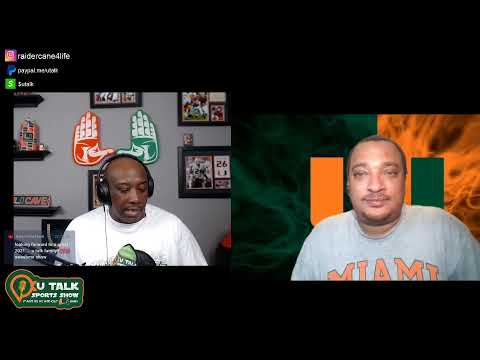
This take grew out of this week’s U TALK LIVE, where the panel and the callers spent the night working through the same wreckage — the injury, the comeback, and the hands that let it slip.
This take grew out of the December 30, 2020 episode — watch it here: Miami Hurricanes U TALK LIVE-73