
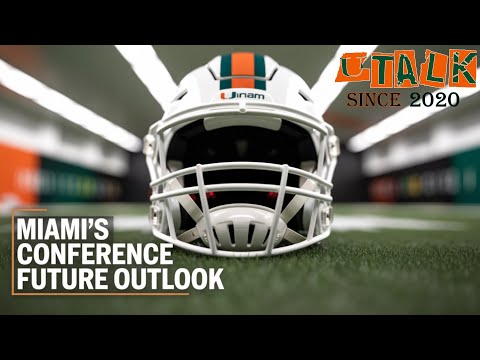
Let’s get the fantasy out of the way first, because every Canes fan reading this has already run the simulation in their head. It’s 2030. The super-conference dominoes finish falling. Somebody’s phone rings in Coral Gables, and it’s a 615 or a 312 area code, and Miami gets to walk out of the ACC like a man leaving a job he outgrew years ago. Cue the graphics. Cue the hype video with the smoke and the turnover chain.
Here’s the problem with the fantasy: in the summer of 2025, Miami is not the guy leaving the job. Miami is the guy hoping the company doesn’t restructure the department out from under him.
Realignment Doesn’t Reward History. It Rewards Leverage.
The thing that keeps getting lost in every barstool realignment debate is that conferences are not sentimental. They are not assembling an all-time greats museum. They are assembling a television inventory. When a league decides who gets an invitation, it is running a very cold calculation: what does this program add to our media rights number, our postseason access, our recruiting footprint, and our brand ceiling — and does it add enough to justify slicing the revenue pie into one more piece?
Miami’s pitch on that spreadsheet is genuinely strange. It is simultaneously one of the most valuable brands in the sport and one of the least productive on-field assets among the programs realignment chatter tends to name. The five national championships are real. The NFL pipeline is real. The South Florida recruiting territory is one of the three or four richest talent zip codes in America and always will be. That’s the asset column, and it’s loud.
The liability column is quieter but it’s the one an athletic director actually reads. Two ten-win seasons in fifteen-plus years. One ACC championship game appearance, and the less said about how that one went the better. One bowl win since 2016. That is not a resume that says “we will win your league.” That’s a resume that says “we will be interesting in your league.”
Those are two very different sales pitches, and only one of them gets you a bigger share.
The Uncomfortable Comparison Is Right Next Door
Clemson and Florida State are the two ACC programs whose names come up first in any exit conversation, and it’s worth being honest about why. It isn’t geography and it isn’t tradition. It’s that both of them have gone out in the modern era and won a national championship. They produced receipts inside the current television landscape, not the one that existed when Jimmy Johnson was coaching.
Miami’s most recent trophy predates smartphones. That’s not a shot at the trophies — those banners are earned and they’re permanent. It’s a statement about how conference math works. A league is buying future inventory, not past inventory. Nobody’s rights deal goes up because of something that happened in the nineties.
So when the question gets posed — would the SEC or the Big Ten actually pick up the phone right now, in July of 2025 — the honest answer isn’t no. It’s “they’d take the call, and then they’d want to see what the next two years look like.” Which is a nicer way of saying the answer is currently conditional. And conditional is a terrible place to be when the music stops.
The Comfort Trap
Here’s the part that should bother the fanbase more than the realignment stuff, because it’s the part fully within Miami’s control.
Somewhere along the way, nine and ten wins became acceptable in Coral Gables. Not celebrated exactly, but acceptable. Tolerable. “Progress.” And there’s a real argument that this is the single most dangerous development in the program’s modern history — worse than any probation stretch, worse than any coaching hire — because a fanbase that accepts mediocrity gives an administration permission to fund mediocrity.
Think about what that does to the realignment conversation. A program that consistently threatens to win the league is a program a bigger league has to price in. A program that reliably finishes around nine wins is a program a bigger league can wait on. There’s no urgency. There’s no bidding pressure. You don’t have to move fast on an asset nobody else is fighting you for.
The uncomfortable version of this is what happens when you strip out the outlier season. Mario Cristobal’s tenure in Miami rests heavily on one healthy year from one transcendent quarterback. Remove that season from the ledger and the record trends the wrong direction. That’s not an indictment of the man — plenty of good coaches have résumés that lean on a signature year. But it is a warning about building a realignment argument on a foundation that thin. You cannot walk into a Big Ten boardroom and say “we’re elite, please ignore fourteen of the last fifteen seasons.”
If It’s Anywhere, It’s the Big Ten
For what it’s worth, the destination logic actually holds up. The Big Ten makes more sense for Miami than the SEC does, and not for the reasons people usually give.
Start with the schedule-strength excuse, which has been Miami’s security blanket for a decade. Every disappointing season gets partially absolved by some version of “well, the ACC schedule didn’t give them a chance to prove anything.” In the Big Ten that excuse evaporates on day one. There is no soft landing. You either win in that league or you’re exposed, permanently, with no available alibi. For a fanbase tired of hearing about strength of schedule, that’s not a downside — that’s a feature.
Then there’s the actual leverage, which is the Miami television market. That’s the real product. Not the helmet, not the history — the market. A conference expanding for reach wants the Miami DMA in its footprint, and that’s a case Miami can make on a spreadsheet even in a down decade.
And here’s the detail that makes it interesting: watch how Cristobal has built this roster. The obsession with the offensive and defensive lines. The emphasis on size, physicality, controlling the line of scrimmage. That is not an ACC-optimized roster construction philosophy. That is a man building a team to survive November in a heavyweight league. Whether that’s conscious positioning or just how he’s wired, the roster is trending toward a style of football that plays in the Midwest.
The Viewership Question Nobody Wants to Answer
Miami averaged 2.41 million viewers, which put the program in the national top twenty. That’s the number that gets waved around in every argument for Miami’s value, and it’s a legitimately strong number.
But there’s a fair follow-up: was that the brand, or was that the quarterback? Because Cam Ward was appointment television, and appointment television travels. The counter-argument — and it’s a good one — is that this is exactly the point. You recruit and develop highlight players precisely because they generate that inventory. Star acquisition isn’t separate from brand value; it’s the mechanism of brand value.
Fine. Then prove it’s repeatable. The 2025 season is the audit. Put up a comparable number without a generational quarterback carrying the broadcast and the argument stops being theoretical. Fail to, and every league office in America quietly relabels Miami from “brand” to “one guy who was fun to watch.”
Build the Thing That Makes the Phone Ring
The context matters here and deserves saying out loud: this program spent three separate stretches on probation in a twenty-year span, went through an administration that starved football of resources for years before the current leadership arrived, and operates on a small private campus that genuinely cannot sell the sprawling big-college experience an eighteen-year-old sees on a visit to Columbus or Tuscaloosa. Those are real structural headwinds, not excuses. But they also explain why the fix has to be on the field, because the field is the only variable Miami can move fast.
So here’s the take, plainly: Miami should stop treating realignment as something that happens to it and start treating it as something it earns. Stop refreshing the rumor accounts. Win the ACC. Win it convincingly, more than once, and the invitation problem solves itself — because nobody is going to leave a genuinely dominant program with the Miami television market sitting in a diminished conference. That’s not how these people operate.
The invitation isn’t the goal. The invitation is the byproduct. Build something worth calling about.
This one grew out of this week’s U Talk Live conversation on conference realignment, where the crew put the hard version of the question on the table and nobody flinched from the answer.
This take grew out of the July 19, 2025 episode — watch it here: “Conference Realignment” Miami Hurricanes U TALK LIVE-258