
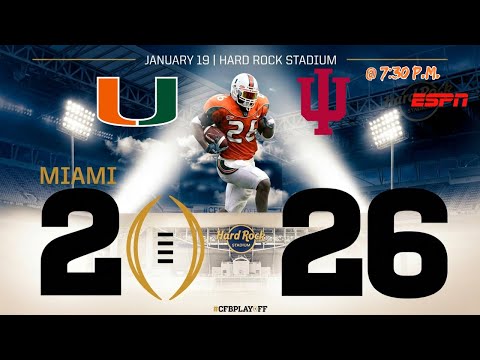
Four days from a national championship game and the loudest thing coming out of U Talk Nation this week wasn’t panic. It wasn’t strategy either, not really. It was recognition. Caller after caller got on the line to describe the same football team using different words, and when you stack those calls on top of each other you get something a whiteboard can’t give you: a fan base that finally knows exactly what it has.
That matters more than it sounds. For twenty-something years, being a Miami fan meant arguing about what the Hurricanes were supposed to be. The ghost of the old dynasty sat in every conversation like an uninvited uncle. Every recruiting class was measured against 2001. Every quarterback was measured against a highlight reel. Every good November got a footnote. We spent two decades building a program in our imagination and then getting mad at the real one for not matching the picture.
The 2025 season broke that habit. Not because Miami suddenly became the 2001 team — it didn’t, nothing will — but because this version of the Hurricanes stopped auditioning for the comparison and started being its own thing. And now that thing is playing for a national title in South Florida against Indiana.
The Tell Is What Nobody Is Arguing About
Here’s what struck me listening to the phone lines light up: there was no disagreement about the game plan. None. Mr. Magic, Chris Kane, the Italian Stallion, B Mike — different callers, different decades of fandom, different levels of film obsession — and they all landed in the same place. Pressure up the middle. Run the football. Make Indiana’s defense play snaps it doesn’t want to play.
Think about how rare that is. Ask ten Miami fans about anything and you’ll get fourteen opinions and two people who hang up mad. But this week the consensus was total, and consensus among a fan base this opinionated usually means one thing: the answer is obvious because the team has made it obvious. You don’t debate the identity of a team that’s been showing you the same identity every single week.
The predictions told the same story from another angle. Twenty-four to thirteen. Twenty-seven to seventeen. Thirty-four to twenty. Thirty to seventeen. Spread across four different callers with no coordination, every one of those scores says the same thing — Miami controls this, Indiana gets held under twenty, and the margin depends only on how many drives the Canes finish. Nobody picked Indiana. Not one person. And here’s the part I want to sit with: that wasn’t arrogance. It was arithmetic. These are people who have watched Miami lose games they were supposed to win for a generation. They’ve earned the right to be paranoid. They chose not to be. That’s a fan base reading a team correctly.
Why the Run Game Is the Whole Argument
Let’s talk about the actual football, because the callers weren’t just vibing — they were scouting.
Indiana doesn’t substitute much on defense. That’s not a knock, it’s a philosophy: you build a top unit, you trust your best eleven, you keep them on the field. It works beautifully across a Big Ten schedule where you play in forty-degree afternoons and half your opponents huddle up and play at a walking pace. It works right up until you’re asked to play a game in South Florida against an offense that intends to make you tackle a running back forty times.
Fletcher, Pringle and Brown aren’t a rotation for style points. They’re a math problem. Three fresh backs against eleven guys who don’t come off the field is an attrition play, and attrition plays don’t pay off in the first quarter. They pay off around the eleven-minute mark of the fourth, when a defensive end who’s been magnificent for three hours takes half a step less on a contain rush and a nine-yard gain becomes a twenty-eight-yard gain. The box score in the second quarter will look boring. That’s the point. The boring quarters are the down payment.
This is also why the calls for trick plays should be ignored entirely, and I’m glad U Talk Nation shot that down without needing to be told. A gadget play is a bet that your straight-ahead stuff isn’t good enough. Miami’s straight-ahead stuff is good enough. Running your actual offense confidently for sixty minutes is not conservative — it’s the most aggressive statement you can make. It says: here’s what we do, stop it.
The Mendoza Problem Is a Clock Problem
On the other side, the read was equally clean. Fernando Mendoza has had a season. He’s also, by the assessment of people who’ve watched every snap of this Miami defense’s year, a beat slower getting the ball out than the quarterbacks the Hurricanes just went through.
A beat is everything. A beat is the difference between a completion and a strip sack. And the specific prescription — pressure up the middle rather than off the edge — is the sharpest bit of scouting the show produced. Edge pressure lets a quarterback climb the pocket and reset his platform. Interior pressure takes his feet away and makes him move laterally, and a quarterback throwing on the move to his left is a quarterback throwing into your linebackers’ hands.
Play man. Mix the looks. Don’t let him get comfortable identifying what he’s seeing pre-snap. That’s not exotic. That’s just doing the hard thing well, repeatedly, for four quarters.
The Part That Isn’t About Football
And then there’s the other thing this week made plain, which is that a home national championship game turned out to be an expensive privilege for the people who kept the faith through the lean years. Nine-hundred-eighty-five-dollar short-term rentals. Five-hundred-dollar rental cars. Ticket brokers running a market that has nothing to do with the fans who sat through November afternoons in a half-empty stadium when there was nothing to play for.
That’s not a complaint you’re supposed to make during championship week. Make it anyway. The people who love this program the most are, statistically, the least likely to be in the building. There’s something genuinely rotten about a program’s biggest night being the one night its truest supporters get priced out of. It doesn’t change the score. It’s still worth saying out loud, and I respect a show that said it instead of pretending everything about this week is perfect.
Six in Twenty-Six
The rallying cry that came out of this week is “6 in 26” — a fifth title, chased in a year that carries number 26 in it, for Sean Taylor. You either feel that in your chest or you don’t, and if you don’t, no column is going to explain it to you.
What I’ll add is this. Melvin Bratton — a man who actually did this, who has a ring and the scar tissue that came with earning it — spent a segment this week talking about visualization. Not as a motivational-poster thing. As a practical, technical instruction: see the play you’re going to make before you make it, because on a night like this somebody is going to end up in the documentary, and the only question is which side of the frame you’re standing on.
That’s the whole thing, really. Miami doesn’t need to invent anything for Monday. No new wrinkle, no gadget, no reinvention. Run it. Rush the A gaps. Cover man. Be exactly the team that got here, sixty minutes long, in the 2025 season’s last act, on home soil. The identity is already built. All that’s left is to go be it.
This take grew out of this week’s championship hype show, where Devin opened the phone lines and let U Talk Nation build the game plan itself — with prayers up for Larry Frank Jr. and his family, who were on everybody’s mind.
This take grew out of the January 16, 2026 episode — watch it here: College Football Championship Hype Show | Miami vs Indiana | U TALK LIVE-293