
Every program has a month where the truth shows up whether you invited it or not. For Miami, that month is January. Not because of what happens on a field — there’s no field left in January for this team — but because January is when the receipts arrive. Coordinator hires. Portal exits. Roster math. The quiet stuff nobody puts on a highlight reel, which turns out to be the only stuff that ever decides how the next season actually goes.
And right now the receipts are ugly.
The Portal Isn’t the Problem. It’s the Diagnosis.
Here’s the thing about transfer attrition that gets lost in the noise: players leaving isn’t inherently a crisis. Rosters churn now. That’s the sport. Every program in America loses guys every December, and the good ones just reload and keep moving like nothing happened.
What matters is which guys leave, and what class they came from.
Miami’s 2022 and 2023 signing classes have been gutted. Jaden Wayne, Robby Washington, Riley Williams — gone. Those aren’t fifth-year seniors aging out of the program on schedule. Those are supposed to be the spine of the roster right now. The 2022 class should be entering its prime. The 2023 class should be the depth that lets you survive an injury without the whole thing collapsing. Instead, both classes have been hollowed out, and what’s left is a roster that looks fine on a depth chart PDF and thin as tissue paper the second anything goes wrong.
Look at the running back room. Three scholarship options. Three. After the Damien Martinez departure and the Mark Fletcher situation, Miami is walking into an offseason with a backfield that couldn’t survive one bad hamstring, let alone a full season in a conference where you get punched in the mouth every Saturday. That’s not a roster. That’s a prayer.
But here’s the part that should genuinely worry you: guys don’t leave programs they believe in. Development is a two-way contract. A player gives you his eligibility, and in exchange he expects you to make him better and put him in position to win. When two consecutive classes decide en masse that the deal isn’t being honored, that’s not bad luck. That’s a verdict. Those kids sat in the building, watched how it operates, watched who gets developed and who gets forgotten, and voted with their feet.
The Guidry Firing Tells You Everything About the Chain of Command
Lance Guidry was fired on December 31. Fine. A defense that surrendered 41 points in a bowl game, that let a 21-0 lead against Syracuse evaporate and take a playoff berth with it, that showed cracks going all the way back to a Week 3 scare against USF — yeah, somebody was going to answer for that.
The problem isn’t the firing. The problem is the reporting that it took booster funding pressure to make it happen.
Sit with that. If accurate, the head coach watched his defense bleed out over an entire season — watched the warning signs in September, watched a 21-point lead disappear in the game that mattered most, watched a bowl game turn into a 41-point demolition — and the decision to move on didn’t come from a performance evaluation. It came from money getting uncomfortable.
That’s a structural failure, not a personnel one. A functioning program identifies problems and acts on them. A dysfunctional one waits until an external force makes inaction impossible, then executes the move and calls it decisiveness. Those are completely different organizations even when the press release reads the same.
And it raises the obvious question about the next hire: if the coach couldn’t independently reach the conclusion that this defense needed to change, what confidence should anybody have that he’ll independently identify the right replacement?
The Alpha Problem
The names floating around the vacancy are legitimate. Jeremy Pruitt. Kevin Steele. Will Muschamp. Clint Hurtt. Georgia Tech’s coordinator. That’s not a bargain bin — those are guys with real defensive résumés and real command presence, guys who’ve run rooms and stood in front of grown men and been believed.
Which is exactly the problem.
Hiring a coordinator with a genuine alpha personality means voluntarily surrendering control of half your football team. It means somebody in the building who will tell you you’re wrong, in front of people, and mean it. It means a coach whose success becomes a referendum on why the rest of the operation isn’t performing at the same level. That’s uncomfortable. That’s a threat to any head coach whose authority rests more on title than on results.
The safe hire is the compliant hire. Somebody talented enough to sell to the fan base and the boosters, deferential enough to never become a problem in a staff meeting. Miami has a long institutional habit of making exactly that hire and then acting surprised when nothing changes.
Here’s the test, and it’s simple enough that you’ll know within a week of the announcement: does the new coordinator get full autonomy over defensive scheme, defensive personnel, and defensive staff hires? Not verbal autonomy at a press conference. Actual autonomy — his calls, his guys, his system, his accountability. If the answer is yes, this program might genuinely be turning something. If the answer is a hedge, a shared-responsibility arrangement, a “we’ll collaborate on that” — then Miami just hired a name to calm the message boards and nothing under the hood has moved an inch.
What Winning January Actually Looks Like
Forget the recruiting rankings for a second. Forget the star ratings and the announcement videos. There are three things that would tell you Miami is fixing the actual disease instead of treating symptoms.
One: the coordinator hire comes with real authority, and it’s visible in how the staff gets built underneath him. Two: the running back room gets rebuilt to genuine depth — not three bodies and optimism, but a room that can absorb injury and still function in November. Three, and this is the one nobody tracks but everybody should: the 2024 and 2025 classes stay. If those groups start walking out the same door the 2022 and 2023 classes did, then nothing was fixed. The building just kept doing what the building does, and a new coordinator’s name on the door didn’t change a single thing about why players decide they’d rather be somewhere else.
Miami doesn’t have a defensive coordinator problem. Miami has a retention problem, an accountability problem, and a chain-of-command problem — and a defensive coordinator vacancy is just the most visible symptom of all three. You can hire a great coach into a broken structure and watch the structure win every time.
The season’s over. The excuses have run out. January is where we find out if anybody in that building understands the difference between fixing a defense and fixing a program.
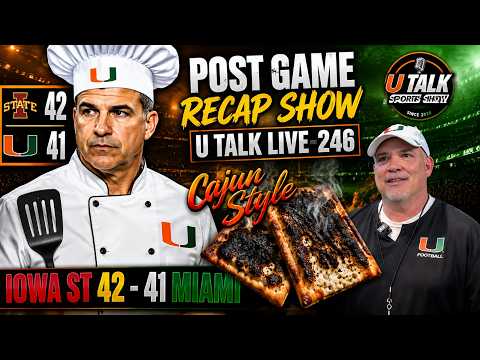
This take grew out of this week’s U Talk LIVE, where Devin and Larry Frank Jr. tore into the state of the roster and the coaching search. Go listen to the full show — they went places this column didn’t.
This take grew out of the January 4, 2025 episode — watch it here: Miami Hurricanes U TALK LIVE-246