
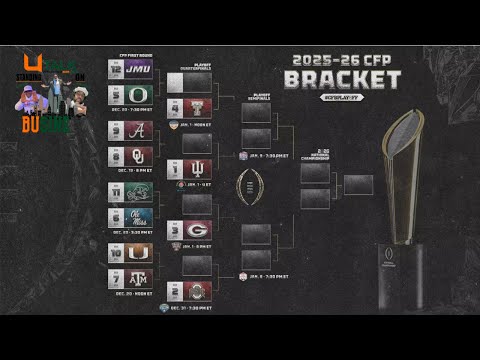
Everybody wants to talk about the bracket. The seeds, the snubs, the committee’s math, the head-to-head tiebreaker that finally — finally — meant something. Fine. Argue it. But if you want to understand why the Miami Hurricanes are packing for College Station and a College Football Playoff game in the 2025 season, don’t start with the selection show. Start with the quietest ten minutes this program has had in twenty years.
The Silent Room
Mario Cristobal told the story on Pat McAfee’s show, and it’s the kind of detail that tells you more about a football team than any stat sheet will. After the SMU loss, he put the first five games of the season on the screen and let it run. No yelling. No whiteboard. No speech. Just film, and silence, for ten straight minutes — until, in his words, the room woke up and realized who the hell they are.
Think about what that takes. Every instinct a head coach has in that moment is to fill the air. Coaches are talkers; that’s the job description. Standing in front of a room full of grown men who just got embarrassed and choosing to say nothing is a bet — a bet that your players are honest enough to look at themselves without a translator. Most rosters aren’t. Most rosters need somebody to tell them what they just watched, because if nobody narrates it, twenty different guys walk out with twenty different excuses and none of them start with “me.”
Miami walked out of that room with one story. You can see it in everything they’ve done since.
Failure Is Not the Enemy of a Playoff Team. It’s the Prerequisite.
There’s a phrase that’s been rattling around the show all week and it deserves more than a passing mention: failure is success. Not failure leads to success. Failure is it. That’s not a motivational poster — that’s a scouting report on how championship teams actually get built.
Here’s the uncomfortable truth about running the table. An undefeated team that never gets punched in the mouth arrives in December carrying an unanswered question, and the postseason is where unanswered questions get answered in public. Miami got their question asked in October, in Dallas, with nothing but a seeding hit on the line. They got to find out who they were when it was still survivable. That plane ride home — the one where nobody’s talking, nobody’s on their phone, everybody’s just sitting there with it — that’s the most valuable four hours this team spent all year.
Compare the alternative. Go 12-0 untested, walk into a playoff quarterfinal, and the first time somebody hits you in the teeth is the first time it costs you a season. Plenty of great teams have died exactly that way. Miami already paid that tuition, and they paid it at a discount.
The Quarterback Question Nobody Should Be Asking Anymore
Carson Beck is healthy. Fully healthy, for the first time all year, per Cristobal himself. The arm is live.
Sit with that for a second, because it recontextualizes the entire season. Every throw you watched and winced at. Every drive that stalled at the 30. Every time you thought “that’s not the guy we were sold” — that was a quarterback playing through a shoulder that wasn’t right, and the people around the program who kept insisting on that all season are getting their vindication in the best possible way: right before the biggest game of the year.
What that means practically is that the Miami you’re about to see in College Station is not the Miami that’s been on your television since September. It’s a different offense when the intermediate throws are actually available. It’s a different defense, too, because a quarterback who can push the ball down the field keeps your defense off the field. Nobody in Texas has film of that team. There is no tape of a fully healthy Carson Beck running this offense in a playoff game, because it has never existed until now.
That’s the single biggest reason to like Miami’s chances, and it’s got nothing to do with seeding.
Texas Isn’t a Road Game. Not for This Program.
Let’s talk about the venue, because the framing has been lazy everywhere else. Yes, Miami is traveling. Yes, Kyle Field is going to be loud and hostile and full of people who have been waiting a long time for a night like this.
But Miami has been recruiting Texas for decades. There are players on this roster who will be playing forty-five minutes from where they went to high school. There will be families in that stadium in orange and green who didn’t have to buy a plane ticket. The idea that this is some alien environment where a Florida team gets swallowed whole doesn’t survive contact with the actual roster.
And there’s a psychological piece the numbers can’t hold. A team that got humbled in Dallas in October and comes back to Texas in December to play for a season — that’s a narrative loop a locker room can feel. You don’t have to manufacture emotion for that trip. It manufactures itself.
The Game Plan Is Not Complicated
Marcel Reed is the whole problem. Not because he’s going to throw for 400 — because the second a coverage holds up and the pocket gets stale, he’s going to pull it down and run, and that’s where drives that should die at third-and-8 turn into first downs and eventually points. You spy him. You accept that spying him costs you a body in coverage. You live with the math, because the alternative is watching him convert with his legs all night and losing by ten while your secondary played beautifully.
On the other side: feed the backfield. Miami has three backs it trusts, and three backs in a hostile stadium is a volume game — you’re not looking for one guy to break a 60, you’re looking to still be pounding it in the fourth quarter with fresh legs while their front seven is on its ninth series of the night.
And the first fifteen minutes matter more than any other stretch of this game. Put fourteen on the board early and you take the crowd out of it, you take the script away from them, and you force a young quarterback into a version of the game he doesn’t want to play. Playoff road games are won by whoever silences the building first.
Last thing, and it’s the fun one: somebody nobody’s discussing is going to have the biggest night of their life. That’s how these games go. A team spends a season with defenses game-planned around its top target, then a healthy quarterback finds the third read in a playoff game and a name you’ve barely said out loud becomes a name you’ll say for twenty years. Miami’s history is a list of guys who became legends on exactly one December or January night. There’s a spot open on that list.
What This Actually Is
Miami is in the College Football Playoff. Not in the conversation. Not on the bubble. In it, with a healthy quarterback, a roster that already survived its own worst day, and a road trip into territory it owns.
The committee didn’t give this team anything. A ten-minute film session in a silent room did. Remember that when kickoff hits.
This take grew out of this week’s U TALK LIVE, where the desk got into Cristobal’s post-SMU team meeting, Beck’s health, and the road through Texas.
This take grew out of the December 12, 2025 episode — watch it here: We’re in let’s discuss it U TALK LIVE-283