
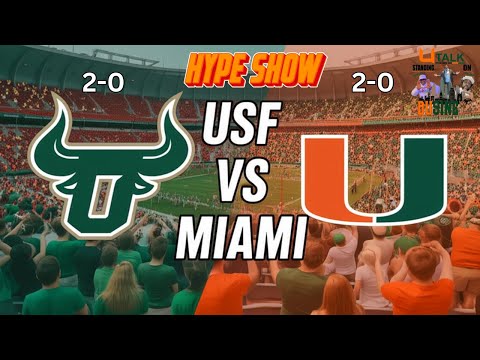
Let’s get the obvious part out of the way: South Florida is a good football team. Not a cute team. Not a plucky team. Not a “nice story” team that gets a paragraph in the national roundup and a pat on the head. They went into the Swamp and beat a ranked Florida squad on the road, and there is no asterisk you can staple to that. Anybody in Coral Gables treating this like a glorified scrimmage before the real schedule starts is setting themselves up to spend Sunday explaining things to their group chat.
But here’s the thing I keep circling back to in the 2025 season, and it’s the part that doesn’t fit neatly on a graphic: the biggest threat to Miami on Saturday isn’t USF’s roster. It’s Miami’s own attention span.
The Emotional Math Nobody Wants To Do
Football is a physical sport played by emotional people. That’s not a soft take, that’s just true. And there is a real, measurable cost to asking a group of 18-to-22-year-olds to get all the way up — the full-body, hair-standing-up, walk-through-a-wall kind of up — three weekends in a row against teams that carry weight.
That’s the schedule Miami is staring at. This isn’t one big game followed by a breather. It’s a stretch. And human beings do not have infinite peaks in them. Ask any player who’s ever come off a huge win and tried to manufacture that same feeling seven days later. The body shows up. The nervous system needs a minute.
Which is exactly the window an opponent like South Florida lives to crawl through. They don’t need Miami to play badly. They need Miami to play normal. Normal is enough to keep a live underdog breathing into the fourth quarter, and a live underdog in the fourth quarter is how you end up on a highlight package you didn’t want to be on.
The Cinderella Formula Is Not A Mystery — It’s A Checklist
Every upset that ever mattered followed roughly the same recipe, and none of the ingredients are exotic.
Ingredient one: the underdog stays within one score into the second half. That’s it. That’s the whole ballgame. Once the crowd starts doing math and the favorite starts pressing, the game changes character entirely.
Ingredient two: the underdog’s quarterback doesn’t turn it over. Not “plays great” — just doesn’t hand out gifts. Survival is a totally valid quarterbacking strategy when you’re the one with less to lose.
Ingredient three: somebody on the underdog side makes two or three plays that had no business happening. A contested catch on third-and-long. A strip that bounces the right way. A busted coverage taken 60 yards. Chaos plays. They aren’t scheme, they’re variance — and variance loves close games the way it hates blowouts.
Notice what’s not on that list: the underdog being better. Cinderella almost never wins by being better. Cinderella wins by hanging around until better stops mattering.
So The Only Real Defense Is Scoreboard Violence, Early
This is why the “put them to sleep” framing isn’t bravado — it’s actual strategy. The single most effective anti-upset tool in football is a two-score lead before halftime. It deletes half the underdog’s playbook. It forces the quarterback out of the game plan he’s most comfortable in. It turns a scrappy defense flying to the ball into a tired defense chasing the ball.
And it removes the chaos plays from the equation, because chaos plays only matter when the margin is thin enough for them to matter. A miracle catch down 24 is a nice clip. A miracle catch down 6 is a season.
Every drive Miami settles for a field goal, every possession that ends in a punt because somebody wanted to be cute, is another log on the fire for a team that already knows it can beat somebody ranked on the road. Confidence is not a fixed quantity in these guys. It compounds. You have to cut it off at the source, and the source is the scoreboard in the first twenty minutes.
The Mobile Quarterback Problem Is A Discipline Problem
Here’s the sub-plot inside the sub-plot. Miami’s history against quarterbacks who can run is the kind of history you don’t put in the media guide. And this stretch of the 2025 schedule is essentially a three-week exam on that exact weakness, with USF’s dual-threat as question number one.
But I want to reframe how people talk about this, because “contain the mobile QB” gets tossed around like it’s a scheme you install on Tuesday. It isn’t. It’s a discipline tax you pay on every single snap.
Rushing lanes have to stay lanes. The end who wins his rep and then over-runs the pocket by two yards has, functionally, just called a designed quarterback draw for the other team. The linebacker who bites on the play-action for half a beat has opened the scramble alley. Coverage has to stay glued for an extra second and a half, and the honest truth is that plaster coverage is an effort statistic more than a talent statistic — it’s about whether your corner keeps his eyes on his man when the play breaks down and everything in his body wants to peek at the quarterback.
That’s the whole thing. Every one of those failure modes is a focus failure, not a talent failure. Which loops right back to the main point of this column: the danger isn’t that Miami isn’t good enough. It’s that a team playing at 90 percent focus against a mobile quarterback creates exactly the escape hatches that turn a comfortable afternoon into a nervous one.
What A Clean Win Actually Looks Like
I don’t need Miami to hang 60. I don’t need a scoreboard operator to file a workers’ comp claim. What I want to see is much less glamorous and much more revealing.
I want the first two possessions to look bored. Not sloppy — bored. Methodical. Like a team that has decided the outcome is administrative. I want the defense to make the quarterback beat them from inside the pocket, and to keep making him do that in the second quarter when the legs and the discipline both start getting tested.
I want to see the response to USF’s first real momentum swing — because there will be one, there always is — handled like a business item instead of an emergency. That’s the tell. Good teams flinch and recover. Great teams don’t flinch.
And most of all I want the fourth quarter to be uninteresting. The most underrated stat in college football is “number of minutes your starters spent on the sideline in a hoodie.” Health matters over a long season, and the cheapest way to buy rest is to build a lead nobody can climb.
The Bigger Picture
Programs that end up where Miami wants to end up in the 2025 season all share one boring trait: they don’t donate games. They don’t have the one Saturday where they show up flat, get punched, and spend the next month explaining it. The gap between a team with a real ceiling and a team with a nice highlight reel is usually just a handful of games that should have been routine and weren’t.
South Florida is going to bring everything they have. They earned the right to believe. That’s not disrespect toward Miami — that’s just what happens when you go win a game in the Swamp. Belief is currency, and they’re carrying a full wallet into Saturday.
The job, then, is simple to describe and hard to execute: take the wallet early. Don’t negotiate. Don’t let the game stay interesting long enough for hope to become a plan.
Handle business, and this becomes a footnote on the way to the real stuff. Let it linger, and it becomes the thing everybody points to later.
This take grew out of this week’s episode of the show, where the crew got into the USF matchup, the mobile-quarterback gauntlet ahead, and what a statement Saturday would actually mean for this team.
This take grew out of the September 12, 2025 episode — watch it here: “USF vs Miami” U TALK Live-265