
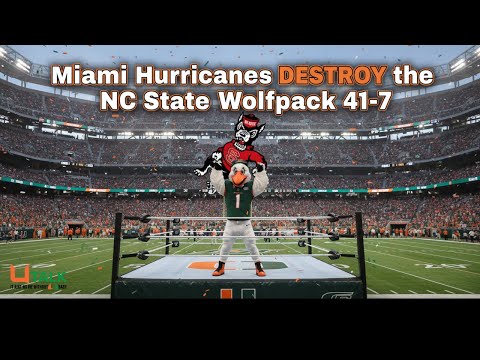
Let’s get the fun part out of the way: Miami 41, NC State 7 was a joy. Trick plays. Tempo. Two backs taking turns punishing a defense that had no answer for either of them. For about three hours on a November Saturday in 2025, the Hurricanes looked like the version of themselves that lives in every fan’s head — the one we describe to people who didn’t grow up on this program, the one that made the U mean something beyond a logo on a hat.
And that’s exactly why it stings.
The Problem With Proof
Here’s the uncomfortable truth about a performance like that: it doesn’t answer questions, it creates them. If Miami had scraped by 24-17 with the same conservative offense we’ve watched all season, at least the story would be coherent. This is who they are. This is the ceiling. Frustrating, but honest.
Instead we got proof. Proof that the creativity existed. Proof that the personnel could execute it. Proof that when this staff decides to actually turn the thing loose, it works — not marginally, not situationally, but 41-7 works. You can’t unsee that. And once you’ve seen it, every close loss earlier in the 2025 season retroactively becomes a different kind of loss. Not “we weren’t good enough.” Something worse: “we didn’t try everything.”
That’s the shift that happened Saturday, and I don’t think enough people have sat with it. Miami didn’t just beat NC State. Miami convicted itself.
Why Programs Do This
I want to be fair, because the lazy version of this column is just yelling at a play-caller. Let me offer the actual mechanism, because it’s more interesting and more damning.
Coaching staffs at this level hoard. That’s the honest word for it. Every trick play, every exotic formation, every wrinkle they’ve drilled in spring and fall camp — it goes in a folder marked LATER. And LATER is defined by risk tolerance. When you’re winning, you don’t need it. When you’re comfortable, you don’t want it. The exotic stuff carries variance, and variance is the enemy of a coach protecting a good record.
So the folder stays closed. Week after week. Until something external forces it open — a loss that changes the math, or outside pressure that makes the status quo more dangerous than the risk.
That’s the pattern, and it’s not unique to Miami. What IS unique to Miami is how thoroughly this program’s identity contradicts it. This is not a hoarding program. This is not a protect-the-lead program. The entire mythology of the U is built on the opposite instinct: we’re going to show you everything we have, right now, and dare you to survive it. The swagger wasn’t decoration. It was a strategy. It was a decision, made repeatedly, to force the game rather than manage it.
You cannot claim that inheritance and then coach scared. Those two things don’t coexist. And for most of this season, Miami has been trying to have it both ways — selling the identity in recruiting pitches and hype videos while playing a brand of football that is fundamentally cautious.
The Reactive Pattern Is the Real Story
One game is an anecdote. A pattern is a diagnosis.
Look at what actually triggers change around here. The defense doesn’t get fixed until it costs a season. The offense doesn’t open up until the losses stack and outside voices start narrating Miami’s shortcomings on national television. A back who can clearly play sits on the scout team until circumstance forces him onto the field, then immediately produces. In every case, the correct answer was available before the crisis. In every case, it took the crisis.
That’s not a play-calling problem. That’s an organizational reflex — a program that responds to pressure instead of anticipating it. And a reactive program has a hard ceiling, because the schedule doesn’t wait for you to figure it out. By the time the wall is at your back, the games that mattered most are already in the loss column.
Here’s the part that should actually worry you: reactive works fine in September. September opponents don’t punish hesitation. November opponents do. Which is precisely why Miami’s Novembers keep looking the way they look — the margin for error vanishes at exactly the moment a reactive program is still gathering information.
What Miami Is Missing Isn’t a Playbook
The playbook is clearly fine. What’s missing is somebody in the building whose job is to be uncomfortable early.
Great teams have an internal antagonist. Not a locker-room problem — an accountability engine. A player, usually, who refuses to let comfort settle in during a three-game winning streak, who makes September feel like November because he won’t let it feel like anything else. That’s what the old Miami teams had in abundance. It wasn’t just talent; it was a culture where somebody would say the hard thing on Tuesday instead of after the loss on Saturday.
This roster has the raw material for that. There are players on this team with the resume and the respect to be that voice. What hasn’t happened yet is the transformation — the moment a talented, well-liked, quietly excellent player decides that being quietly excellent isn’t enough. That transformation isn’t automatic. It has to be invited, and sometimes it has to be demanded. The U has historically been very good at demanding it.
Coaches can’t manufacture that. Coaches can only create the conditions for it and then get out of the way. And it’s worth asking whether a staff culture built on control — on hoarding the folder, on managing risk, on staying reactive — actually leaves room for a player to grow into that role.
The Uncomfortable Ask
So where does this leave us in mid-November of the 2025 season?
With a football team that just proved it’s better than its record, which is the most agonizing thing a football team can prove. With a path forward that now depends on results Miami doesn’t control — the kind of math that only exists because of games Miami did control and let slip.
And with a question that outlives this season entirely: does anything change structurally, or did we just watch a very entertaining one-off?
Because if the folder closes again — if next season opens with the same cautious script and the same wait-for-the-crisis reflex — then Saturday wasn’t a breakthrough. It was a tease. A reminder of what’s sitting in the building, unused, while the program tells itself it’s saving it for the right moment.
There is no right moment. There’s only the game in front of you. The old Miami understood that in its bones. That’s the actual inheritance, and it’s got nothing to do with turnover chains or entrance smoke. It’s a philosophy: play like the folder is empty, because you emptied it.
Forty-one to seven was Miami remembering. The only thing that matters now is whether Miami keeps remembering when the stakes go back down.
This take grew out of this week’s Recap Show breakdown of Miami’s win over NC State, where the crew got about ten minutes of celebration in before the bigger question took over the room. Worth your time if you want the full argument.
This take grew out of the November 17, 2025 episode — watch it here: Recap Show NC State 7 -41 Miami U TALK IVE-280