
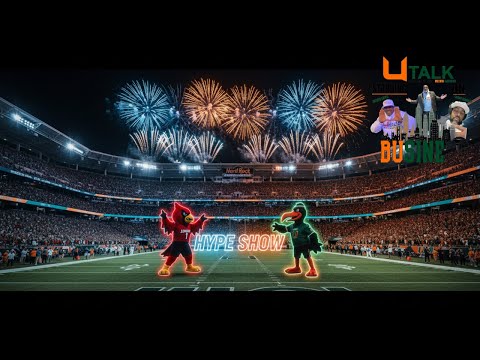
Miami is 5-0. Louisville comes to Hard Rock at 4-1 on a Friday night with the ESPN cameras on and the whole country with nothing else to watch. And the thing standing between this team and a real playoff conversation in the 2025 season isn’t a scheme, isn’t a quarterback, isn’t a depth chart. It’s about eleven minutes of game clock that this program keeps handing back like it’s being polite.
Let’s be blunt about it, because that’s the only way it gets fixed: the Canes have developed a habit of building a lead like a championship team and then protecting it like a team that’s afraid of it. Florida State is the exhibit everybody keeps pointing at, and rightfully so. Miami had that game in a box. Then the play-calling shrank, the tempo died, the aggression got put in a drawer, and a beaten opponent got to stand up, dust off, and start believing again. Miami won. Fine. Winning is the only stat that goes in the ledger. But anybody who watched it knows what they watched.
Conservatism Isn’t Safety. It’s a Different Kind of Risk.
Here’s the part that coaches at every level get wrong and that fans understand instinctively: playing not to lose is not the low-risk option. It just moves the risk somewhere you can’t see it.
When you go three-and-out on purpose — and that’s what a conservative fourth-quarter series is, a three-and-out you scheduled in advance — you’re not shortening the game. You’re lengthening the other team’s. You put your defense back on the field tired. You give the opponent’s offense reps, rhythm, and confidence. You hand a struggling quarterback the one thing he’s been begging for all night: a clean series with no scoreboard pressure and a defense that just ran forty snaps.
Momentum in football isn’t mystical. It’s oxygen. It’s a tired defensive end who can’t get off a block on third-and-six in the fourth because he’s played sixteen more snaps than he should have. That’s not vibes. That’s math, and the math is on the play-caller.
The uncomfortable truth is that the national media has started noticing. When you’re an undefeated team in October and the storyline attached to your name is “they let teams hang around,” that’s a label that follows you into November and shows up in a committee room in December. Style points aren’t supposed to matter. Everybody knows they do.
Why Louisville Is Exactly the Wrong Opponent to Be Nice To
On paper this game breaks Miami’s way and it isn’t close. Louisville is banged up in the backfield — three running backs unavailable — and their offensive line has been one of the worst in the country at keeping the quarterback clean. That’s the specific ingredient list for a Rueben Bain Jr. and Akheem Mesidor evening. A team that can’t run it and can’t protect against a front like Miami’s front is a team that should be down three scores before it figures out what it wants to be.
But that same profile is precisely what makes fourth-quarter mercy so dangerous here. A team with a compromised run game and a leaky line has exactly one way back into a football game: explosive passing. And Louisville has the guy for it. Their receiver Bale is a legitimate top-of-the-draft talent — a big-bodied, catch-radius nightmare in the Deebo Samuel mold, the kind of player who doesn’t need ten targets to change a score. He needs three. If you play soft coverage in the fourth because you’re up two touchdowns and “just don’t want to give up the big one,” you have designed the exact conditions in which he gets the big one.
That’s the trap. Playing off a receiver like that isn’t protection. It’s an invitation with a stamp on it. You press him, you jam him, you make somebody on that roster other than him beat you — and you do it for sixty minutes, not for forty-five and then a prayer.
The Friday Night Variable Is Real
There’s another wrinkle here that veterans of this sport will tell you about and that stat sheets don’t capture: Friday night games get weird. Short week rhythm, a different body clock, a national audience, an opponent who knows the whole country is watching and plays fifteen percent above their tape because of it. Underdogs love a stage. Louisville is walking into a building where every recruit in the region is watching and every one of their guys knows a big night on ESPN changes their spring.
Combine “opponent playing above their level” with “Miami easing off in the fourth” and you’ve got a scoreline that gets a lot closer than the talent gap says it should. That’s not a doomsday take. That is literally the pattern this team has already run twice this year.
The Historical Receipt Nobody in Coral Gables Should Forget
Miami football has an actual, documented, painful history with exactly this disease. In 1984, this program led Maryland 31-0 and had to live with what came after. Two weeks later came the Flutie throw in the Orange Bowl — a game that has outlived everybody who played in it, that gets replayed every single November, and that is remembered not as a triumph of Boston College so much as an indictment of a Miami team that had a game won and let a door stay open.
Guys who wore the uniform in that era don’t tell that story for nostalgia. They tell it because it never actually stopped being relevant. The scoreboard doesn’t remember that you were the more talented team. It only remembers the number at zeroes.
That’s the tax on letting teams breathe: you don’t pay it every week. You pay it once, and the bill is enormous, and it arrives on the week you can least afford it.
What a Fixed Version of This Team Looks Like
It’s not complicated, and that’s what makes it maddening. Whatever built the lead — keep doing it. If tempo built it, stay in tempo. If shot plays built it, keep taking shots. If pressure built it, keep sending it. The single most common self-inflicted wound in football is a staff that abandons the exact identity that produced the twenty-one-point advantage, then acts surprised when the advantage evaporates.
Nobody is asking for cruelty. Well — some of us are, honestly. But the actual argument is simpler than running up a score: a football team should play one way for four quarters. Consistency is a skill. It gets practiced or it doesn’t exist. And a team that’s never rehearsed closing games in October is not going to suddenly discover how in a playoff game in December.
The good news is that the fix requires no new personnel, no transfer portal miracle, no scheme overhaul. It requires a decision. Miami has the front seven to make Louisville miserable, the receivers to stress a secondary that’s going to be on the field too long, and a roster that at 5-0 has earned the right to believe in itself. All that’s left is the willingness to keep the foot down when the game is already won.
Beat them in the first quarter. Beat them again in the fourth. Make it boring. Boring is a championship trait.
This take grew out of this week’s HYPE SHOW on U TALK LIVE, where the crew broke down the Louisville matchup and the fourth-quarter conversation got real. Go watch the whole thing — the history lesson alone is worth the click.
This take grew out of the October 17, 2025 episode — watch it here: “HYPE SHOW” Louisville vs Miami U TALK LIVE-272