
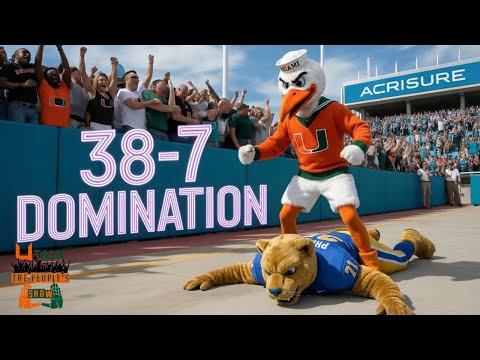
Forget the bracket for a second. Forget the tiebreaker math, forget the committee room, forget whatever Selection Tuesday is about to do to your blood pressure. Miami just finished the 2025 regular season at 10-2 with a 38-7 dismantling of Pitt on the road, and the number that should be tattooed on every talking head’s forehead before they open their mouth this week is this one: 4-0 against ranked teams.
Four-and-oh Is Not a Stat. It’s a Character Reference.
Anybody can go 10-2. You can go 10-2 by beating up on a schedule made of wet paper and then losing the two games where somebody punched back. That’s the standard-issue 10-2 — the kind that gets a program a nice bowl trip and a coach a contract extension and absolutely nothing else.
This isn’t that. Miami went out four separate times against a team with a number next to its name and won four separate times. Not survived. Won. That is the hardest thing to fake in college football, because ranked opponents are the only ones with the roster to expose you when your quarterback has a bad half or your secondary gets a bad matchup. You cannot scheme your way to 4-0 against ranked teams. You cannot get lucky your way there four times in a row. At some point the ball stops bouncing and you either have dudes or you don’t.
Miami has dudes. The résumé says so in the only language that can’t be spun.
The Pitt Game Was the Part Everybody Should’ve Been Watching
Here’s what makes me want to grab people by the collar. The Pitt game got treated like a formality — a box to check on the way to the real drama. It was the opposite. It was the most revealing sixty minutes of the season.
Think about the specific setup. Road game. Cold weather. Late-season finale. A team that’s already been told by the conference office that its championship-game hopes are cooked on a technicality. Every single ingredient in the historical recipe for a Miami collapse was sitting right there on the counter, pre-measured. We have all watched this movie. We have all been in the group chat at halftime typing “here we go again” with our thumbs shaking.
Instead, the Canes beat the brakes off Pitt 38-7 and had it functionally decided by the third quarter. Not a grind. Not a survive-and-advance. A deflation. Pitt quit before the fourth quarter started, and Miami made them quit.
That’s the whole thing. That’s the culture answer. For fifteen-plus years the knock on this program wasn’t talent — it was temperature. The Canes always had guys who’d go in the first round; what they didn’t have was a team that showed up when the stakes were removed and the weather was bad and nobody was going to hand out a trophy for it. A team with nothing tangible left to play for went on the road and put up 38 anyway. That’s not a stat line, that’s a mission statement.
The Two Losses Are Real. Own Them. Then Move On.
Let’s not be the fanbase that can’t take a punch. There’s a version of this argument that says the two losses were games Miami should have won, that if the Canes just handle their business none of this committee drama exists, and that whining about the process is a bad look when you left points on the table yourself.
That take is correct. It’s also incomplete, and the incompleteness is where the actual crime lives.
Because the standard being applied isn’t “did you lose twice.” Two-loss Alabama gets described as a sleeping giant. Two-loss Oklahoma gets described as battle-tested. Two-loss Miami gets described as unproven. Same record, three different vocabularies. The grace is distributed by brand, not by body of work — and Miami, despite five national championships and a decade of being the most feared thing in the sport, somehow never gets issued a card.
So yes: own the two losses. And also refuse to accept a grading curve that only bends for other people.
The Notre Dame Comparison Isn’t Close, and It’s Not Subjective
If you want the cleanest illustration of the double standard, it’s sitting right there in the Notre Dame conversation. Head-to-head: Miami won. Ranked wins: Miami 4-0, Notre Dame 2-2. Common opponents: Miami beat four of five by wider margins.
That is not an argument. That is a verdict with three independent corroborating witnesses. Head-to-head is the tiebreaker every sport on earth uses first. Quality wins is the metric the committee itself says it values most. Margin against shared opponents is the control group. Miami swept all three. There is no fourth category where Notre Dame closes the gap unless the category is “vibes” or “television households,” and if that’s the category, then let’s stop pretending we’re doing analysis and just admit we’re doing casting.
The Real Structural Problem: Nobody Is Blocking For These Guys
Here’s the part that should bother Canes fans longer than this week does.
The SEC and the Big Ten function like unions. When one of their members has a debatable case, the entire conference apparatus — commissioners, network partners, the whole ecosystem of former coaches on television — spends the week making that case in public, loudly, in unison. It’s not a conspiracy. It’s just institutional self-interest working properly.
The ACC does not do this. The ACC watched a 10-2 team with four ranked wins get shut out of its own championship game because of a fractional difference in opponents’ combined winning percentage — the very last tiebreaker on the list, after everything else came out even — and then said essentially nothing on that team’s behalf. A 7-5 Duke team went instead. Whatever you think about the rulebook, the conference’s job after applying a rule that ugly is to spend the next two weeks screaming about how good its second team is. Instead: silence.
That’s why the independence talk and the ACC-Big 12 merger talk keeps coming up, half-joking and half-not. It’s not really about scheduling or money. It’s about the fact that Miami is currently paying dues to an organization that provides no representation. If the conference isn’t going to advocate for you in the only month where advocacy converts to actual outcomes, what exactly is the membership fee buying?
The Tell: Even the Haters Switched Sides
You know a case is airtight when the prosecution starts making your closing argument for you. Nick Saban — not exactly a man who hands out participation ribbons, and not exactly a lifelong Miami sympathizer — said the Canes would be the most dangerous team in the playoff. People who have spent years building entire segments around dunking on this program suddenly found themselves arguing that Miami’s getting robbed.
When your critics have to defend you, the argument is over. Everything after that is just waiting to find out whether the people with the votes were paying attention.
What Actually Matters Now
Here’s my honest read heading into Selection Tuesday: the committee’s decision will tell us something important, but it won’t tell us anything about this football team. That question got answered in the cold in Pittsburgh.
If Miami’s in, the rest of the field should be genuinely nervous, because a squad that’s already beaten four ranked opponents and just proved it doesn’t fold in hostile conditions is the exact profile that ruins somebody’s season in round one. If Miami’s out, the takeaway isn’t that the Canes weren’t good enough — it’s that being good enough was never the actual criteria, and the program should plan its next decade accordingly.
Either way, 10-2 with four ranked scalps and a road blowout to close it is a foundation, not an apology. Whatever the bracket says Tuesday, this team stopped being the punchline. That part’s not up for a vote.
This take grew out of this week’s U Talk Live recap show, where Larry Frank Jr. and AO went back and forth on the tiebreaker, the Notre Dame case, and whether the ACC is worth staying in. Worth your time — go listen.
This take grew out of the December 1, 2025 episode — watch it here: Recap Show Miami 38 – 7 U TALK LIVE-282