
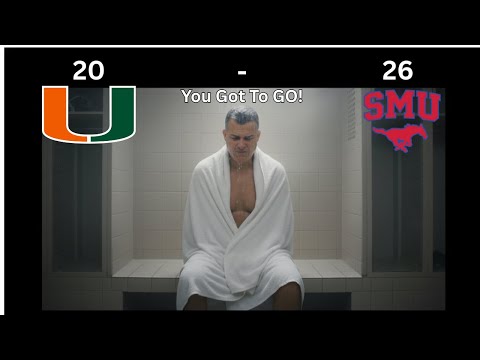
Let’s put the pitchforks down for one column. Not because they aren’t earned — Miami is 20-26 to SMU, that’s two straight losses, and the temperature in this fan base is somewhere between boiling and criminal. But the loudest version of this argument has already been had, on the airwaves and in every group chat in Dade County. Fire him. Don’t fire him. He needs time. He’s had time. Everybody’s got their side and nobody’s moving.
I want to talk about something underneath all that. Because the thing that’s actually broken at Miami in the 2025 season isn’t a play call, a November hex, or a coach who can’t win a big one. It’s a structural mismatch. Miami built a roster like one kind of program and coaches it like a completely different one.
You Cannot Recruit Like Alabama and Play Like a Mid-Major
Here’s what nobody disputes, not even the people screaming for a change: Mario Cristobal recruits. Top-ten classes. Top-ten NIL. Top-ten portal hauls, every single year. That’s not spin, that’s not homerism, that’s just the receipts. In an era where the ability to assemble talent is the single most transferable skill in college football, Miami has one of the two or three best assemblers in the sport sitting in the head chair.
And that’s exactly the problem. Because assembling talent and deploying it are two entirely different jobs, and Miami keeps grading one of them on the strength of the other.
When you stack blue-chip talent at that rate, you are implicitly making a promise about how that talent gets used. You’re saying: we will out-athlete you, and we will also out-scheme you, because we have the margin to be creative. Great rosters buy you the right to be aggressive. They buy you fourth downs. They buy you tempo. They buy you the confidence to play from ahead instead of playing not to lose.
Miami collects the talent and then coaches like a program that’s scared of it. That’s the disconnect. That’s why the fourth quarters keep going sideways. It’s not that the players aren’t good enough — it’s that the operating philosophy was built for a roster that doesn’t exist here anymore.
The November Thing Is a Symptom, Not the Disease
Everybody knows the November numbers by now. One and three in 2022. One and three in 2023. Two and two last year, and that was with Cam Ward under center, which should tell you everything about how much of that record was a quarterback carrying a philosophy on his back. Now 2025 opens November at 0-1.
People treat that as a curse. It isn’t. November is just when the schedule stops letting you get away with it.
Early in a season, superior talent papers over an enormous amount of structural sloppiness. You can win by two touchdowns while doing three things wrong, and everyone leaves happy and the ranking goes up. That’s the fool’s gold everybody’s talking about — not fake wins exactly, but wins that don’t test the thing that’s actually fragile. Then you hit the back half, the opponents get better and the margin shrinks to a possession, and suddenly the game is decided by exactly the stuff that got papered over. Situational football. In-game adjustment. Whether your system has an answer when Plan A stops working.
That’s not a November curse. That’s a program whose floor is high and whose ceiling is bolted shut. And when the floor is that high — nine wins, always, every year, like clockwork — the bolt on the ceiling is really hard to see until the second week of November.
The General Manager Idea Is Right for the Wrong Reason
The most interesting thing floating around the fan base right now is the idea of moving Cristobal into a general manager role. Let him own personnel and relationships — the stuff he’s demonstrably elite at — and bring in a head coach to run the actual game.
Most people are pitching that as a soft landing. A way to keep the recruiting without the game-day pain. A face-saving exit ramp.
I’d argue it’s not a compromise at all. It’s the correct organizational design, and Miami stumbling toward it out of frustration doesn’t make it less correct.
Look at where college football actually is. Roster construction is now a year-round, full-time, cap-management, relationship-brokering job. It is not a side hustle you do between installing a game plan and watching film on a Tuesday. Programs all over the sport are separating those functions because the sport separated them. The head coach who also personally runs personnel at a top-ten NIL operation is a guy doing two full-time jobs, which means he’s doing at least one of them at maybe seventy percent.
Miami’s version of that seventy percent has a name. It looks like a program that can get anybody to sign and can’t get anybody to the mountaintop.
The Willis McGahee Thing Tells You What You Need to Know
I keep coming back to the McGahee situation, and not for the reason most people are mad about it. Yes, blocking a Miami legend over podcast associations is a bad look. Yes, the optics of policing the alumni orbit while the on-field product is bleeding are indefensible.
But the diagnostic value is what gets me. That’s a bandwidth story. That’s a leadership structure where the guy at the top has enough attention to spend on who’s allowed in the building — and by inference, not enough to spend on the third-and-six package. You don’t get to micromanage the perimeter and the X’s and O’s. Nobody has that many hours. Every top program that works has ruthlessly decided which of those things the head coach touches.
Miami’s answer appears to be everything, which functionally means nothing gets the full weight.
What Miami Actually Has to Decide
Here’s the honest fork in the road, and it has nothing to do with anybody’s feelings about Mario personally.
Option one: Miami decides the current ceiling is acceptable. Nine wins, a good bowl, a top-twenty finish, a top-five class every February, and a very real chance the roster is better than the record every single year. That’s a fine program. Plenty of schools would take it forever. But if that’s the choice, then stop selling championship expectations to a booster class that’s writing championship checks. The coldest thing anybody said this week came from an actual booster who called the money being lit on fire. He’s not wrong about the arithmetic. You cannot charge playoff prices for a nine-win product.
Option two: Miami decides the ceiling is unacceptable and restructures the job so the two skills — acquisition and deployment — are held by two different people who are each elite at their half. That’s harder, it’s more expensive, it requires an athletic department with real conviction, and it means admitting a hire didn’t work the way it was drawn up without setting the recruiting operation on fire.
What Miami cannot do is option three, which is the one it’s currently running: keep buying a championship roster, keep running a nine-win operating system, and keep acting surprised in the second week of November. That’s not a plan. That’s a habit.
The 2025 season isn’t over. There’s still football to play and this team is still capable of things. But whatever happens the rest of the way, the question the University of Miami has to answer this offseason isn’t whether Mario Cristobal is a good football coach. He’s a good football coach. The question is whether he’s the right shape for the job Miami actually needs done — and whether anybody in that building has the nerve to redesign the job instead of just recycling the argument about the man.
This take grew out of the conversation on this week’s U Talk recap show, where the phone lines went places the polite version of this debate never does. Go listen to the callers. They’ve been ahead of the national take on this program for a while now.
This take grew out of the November 3, 2025 episode — watch it here: Recap Show Miami 20 – 26 SMU U TALK LIVE-276