
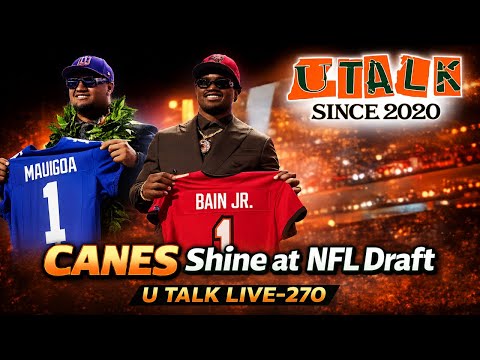
Nine. That’s the number that ought to be spray-painted across every wall in Coral Gables this week. Nine Hurricanes heard their names called in the 2026 NFL Draft. Three of them went in the first round. And if you’ve been around this program long enough to remember when a Miami draft weekend meant sitting through two days of nothing and hoping a special-teamer got a Saturday phone call, you understand exactly what just happened.
This isn’t a fluke class. This is a receipt.
What Nine Actually Means
Draft numbers get thrown around like confetti, so let’s be precise about why nine matters more than it sounds. A one-off first-rounder means you recruited a freak. Two first-rounders means you recruited two freaks. But nine drafted players across a full weekend? That’s a roster. That’s depth. That’s a development staff turning three-star bodies into Sunday paychecks and a strength program that held up over four years instead of four games.
You can luck into a top-five pick. You cannot luck into nine. Nine means the guys who were the fourth option in a rotation were also good enough to get drafted. Nine means the scouts who came to campus to look at Rueben Bain stayed to write reports on somebody else. That’s the whole ballgame in college football recruiting — not the one guy you sell, but the seven guys behind him that other programs suddenly have to explain away.
And it lands at the exact moment Miami needed it to land. Every recruiting pitch in America right now is some version of “we’ll get you to the league.” Most of them are vapor. Miami just walked into every living room in South Florida with a piece of paper that has nine names on it and three of them circled in the first round. Try arguing with that.
Francis Mauigoa and the Position That Sells Itself
Let’s talk about the least glamorous, most important part of this class: Miami put an offensive lineman in the first round.
Francis Mauigoa going in round one is the kind of thing that doesn’t trend on social media and absolutely changes how a program gets recruited. Skill players pick schools for touches. Linemen pick schools for tape and technique and a coach who can prove he’s done it. Every big man in Florida just watched a Miami tackle get first-round money. That’s a five-year recruiting advantage in one televised sentence.
It also says something about what this staff has actually been building. A first-round tackle isn’t a highlight-reel product. He’s a two-a-day product. He’s a film-room product. He’s the result of somebody grinding footwork and hand placement for three years with no reward until draft night. When a program starts producing offensive linemen at that level, it means the boring parts of the operation are working — and the boring parts are the parts that decide whether you’re a ten-win team or a four-loss team pretending.
The Defensive Line Is the Brand Again
Rueben Bain Jr. and Akheem Mesidor both going in round one is the sentence that makes old heads emotional, and they’ve earned the right to be.
There is no Miami identity without a defensive line. Not a stylistic preference — an identity. The swagger everybody tries to bottle and sell in a hype video was never really about the celebrations. It was about the fact that for two decades, if you played the Hurricanes, your quarterback was going to get hit more times than he’d been hit all season, and there was no scheme answer for it because the problem wasn’t scheme. The problem was that Miami had four guys who were simply better than your five.
Two first-round defensive linemen in a single class is that formula coming back online. And it should reframe how everybody talks about this program going into the 2026 season. The conversation for years has been about quarterbacks and transfer portal splash and who’s running the offense. Fine. But Miami has never won because of its offense. Miami wins when the defensive front is the most talented unit on the field and the offense just has to not lose the game.
Bain landing in Tampa Bay carries its own poetry, and Hurricanes fans of a certain vintage have already made that connection out loud. A dominant Miami lineman, a Tampa uniform, and a chip on the shoulder is a combination this sport has seen before. It didn’t end well for the rest of the league.
The Sixth-Round Story Is the Real Story
Here’s the part that should actually make you angry, and anger is useful in May.
Keontra Scott went in the sixth round. Watch the tape and try to explain that to me. You can’t. Nobody can. Which means the explanation isn’t on the tape — it’s somewhere in the process, the measurables, the whisper network, the pre-draft machinery that has never once known what to do with a Miami defensive back who doesn’t fit a spreadsheet.
And honestly? Good. Every great Miami secondary of the last thirty years was built out of guys who got told they were a half-step slow or an inch too short. The sixth round is where careers get made by men who never forget the five rounds in front of them. If Scott turns into what the tape says he is, some team just got the best value of the entire weekend, and thirty-one front offices are going to spend four years pretending they had him graded higher than they did.
The slide is also a warning for the guys still on campus. Draft position isn’t a reward for being good. It’s a negotiation, and there are forces in that room that have nothing to do with football — agent relationships, medical flags, stale off-field chatter that gets dredged up with no findings attached. Bain himself dealt with the arm-length noise and a two-year-old car accident with no citation on it. Talent is the entry fee. It is not the whole transaction.
What This Sets Up
The most dangerous thing about a class like this is celebrating it as a destination instead of a checkpoint. Nine drafted players is also nine roster spots that have to be replaced, and the 2026 season doesn’t come with a grace period for graduation losses. Nobody’s going to spot Miami a loss because the defensive line went pro.
But the pipeline is the point. Mark Fletcher is already the name being written on next year’s first-round board, and the description that keeps coming back is a modern-day power back with real hands — the kind of profile that doesn’t slide anywhere. That’s what a healthy program looks like: you don’t mourn the departures, because the next wave is already visible from here.
“We don’t rebuild, we reload” has been a T-shirt slogan for a long time. Slogans are cheap. Nine names in one weekend, three of them in the first round, an offensive tackle and two defensive linemen among them — that’s the slogan finally showing up with documentation. Miami didn’t announce it was back. The league just did it for them.
Where This Came From
This take grew out of this week’s U Talk Live conversation, where Devin and Larry Frank Jr. broke down the whole Hurricanes draft weekend — the first-round trio, the Bain slide, and the sixth-round call that still doesn’t add up. Worth your time if you want the full argument.
This take grew out of the May 9, 2026 episode — watch it here: Canes Shine at NFL Draft U TALK LIVE-297