
There’s a version of the entrepreneurship story that gets told at conferences. Market research. Focus groups. A gap in the category. A deck. Somebody says “white space” out loud and nobody laughs.
Then there’s the real one, the one that actually built most of the Black hair care you trust: a woman awake at two in the morning, a newborn on one side, a mixing bowl on the other, hair coming out in her hands and in her daughter’s, and nothing on the shelf that works. That’s not a business plan. That’s a problem you can’t put down. And in this culture, that has always been the better starting line.
Necessity beats a business plan every single time
Candas Nichole didn’t set out to launch a product line. She set out to fix her own head. Postpartum shedding hit her and her daughter at the same time, the store-bought stuff wasn’t cutting it, and the only lab available was her kitchen between nursing sessions. What came out the other side was Afro Essentials — sulfate-free, plant-based shampoo, a detangling conditioner, skin care, a body cream.
Pay attention to the sequence there, because it’s the whole thing. The product came before the brand. The need came before the product. Nobody was chasing a trend; somebody was solving a Tuesday.
That’s a different animal than a company that identifies “multicultural hair” as a growth vertical in a quarterly and reverse-engineers a bottle to fit it. One of those formulas is built by somebody who has to use it. The other is built by somebody who has to sell it. You can feel the difference in your hands within about three washes.
“The integrity of the hair” is a whole philosophy in five words
Nichole frames her approach around what she calls the integrity of the hair — and she’s explicit that it’s a stance against the lace-front trend, not a shot at anybody who wears one. Read it as a priority order, not a purity test.
Because here’s the tension the natural hair market has never fully resolved. An enormous amount of the industry’s money is in coverage. Wigs, extensions, units, installs — a business built on what sits on top of the hair. There’s real artistry there and real money in it, and Nichole herself came up doing hair for film, television, and music videos, so she’s not standing outside the industry throwing rocks.
But coverage and health are different businesses with different incentives. If your revenue depends on what goes over the hair, you have no particular reason to care what’s happening underneath it. If your revenue depends on the hair itself, you can’t afford not to. Choosing integrity as your organizing principle is choosing the slower, harder, less scalable side of that split — and saying so out loud in a market that rewards the opposite.
The acquisition trap: how a shelf full of “natural” goes quietly fake
Now the part that should make every consumer reading this go check a label.
The pattern discussed on the show is one the culture has watched play out over and over: a well-known “natural” hair brand starts Black-owned, builds a following on formulas that genuinely work, gets acquired by a commercial company — and then the ingredients quietly get swapped for cheaper ones. Same bottle. Same font. Same shelf position. Same loyal customer reaching for it on autopilot. Different product.
That’s the trap, and it’s an elegant one, because it weaponizes the exact thing that made the brand valuable. Your trust is the asset being sold. You built it by telling your cousin, your coworker, your barber. Then it changes hands, and the new owner monetizes the goodwill you generated by degrading the thing that generated it. Nobody announces it. There’s no press release that says “we made it worse.” You just notice, six months later, that your hair doesn’t feel the same, and you assume something changed about you.
So what do you actually do with that? A few things, and none of them require you to become a chemist.
Know who owns what. Ownership is public information for most brands of any size, and it changes. The bottle won’t tell you; a search will. Read the ingredient panel on a product you’ve used for years — not to decode every word, but to notice when the order shifts, because ingredient lists run in descending order by amount and that order is where cost-cutting shows up first. And trust your own head over the marketing. If it stopped working, it stopped working. You’re not imagining it.
The customer who becomes the investor
Something happened on this show that’s worth sitting with. A caller — a guy who follows Black-owned hair care as a consumer — floated becoming an investor, live, on the air. Not a pitch meeting. Not a demo day. A phone call.
That’s the capital pipeline our businesses have actually always had, and it’s the one the ecosystem talks about least. The conference circuit sells founders on venture money and accelerator cohorts, and for the overwhelming majority of Black-owned consumer brands, that money never shows up. What does show up is the customer who believes in the thing and has some money. The uncle. The barber with a paid-off shop. The nurse with a 401(k) and an opinion.
That’s not a consolation prize. In some ways it’s a structurally better deal — because that investor is also your test market, your distribution, and your quality control. He’s going to use the product. He’ll tell you when the formula slips. He is, by definition, not going to buy you out and cheapen the ingredients, because he’s the one washing his hair with it.
The through-line: don’t let anybody discount you
The other hard truth of the night was about friends and family — the ones who want the homie rate, the ones who can’t quite see the business standing where the person they’ve always known is standing.
Tie that back to everything above and the pattern is the same shape at every scale. Undercharging your cousin, taking a low acquisition offer, letting a distributor squeeze your margins until the only way to hit the number is a cheaper surfactant — those are the same decision at different price points. It’s the decision to let somebody else set what your work is worth.
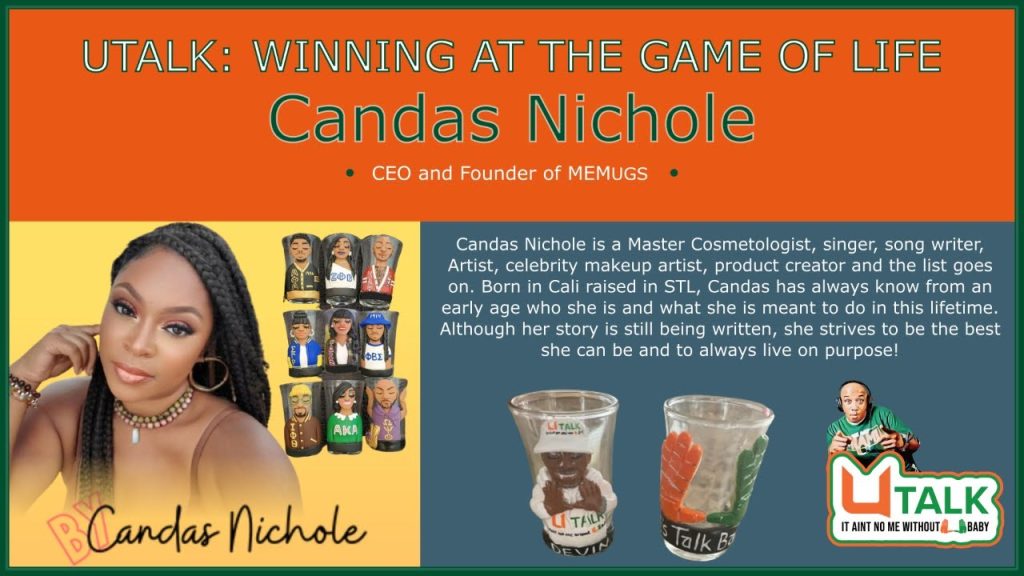
Nichole’s answer to it runs through both her ventures. When a maker botched her own custom order, she didn’t complain and move on — she learned to hand-mold and hand-paint the clay herself and turned it into a second business selling custom pieces made from customer photos. Same reflex as the 2 a.m. mixing bowl. The thing you needed didn’t exist at the standard you needed it. So you built it.
That’s the whole formula. It doesn’t scale cleanly and it doesn’t fit on a slide. It just works.
This take grew out of this week’s U Talk Winning At The Game Of Life conversation with Candas Nichole — master cosmetologist, singer, shot-glass artist, and founder of Afro Essentials — who walked Devin and Larry Frank Jr. through the whole road from doing church ladies’ hair in the sixth grade to building a product line from her own kitchen. Worth your time in full.
This take grew out of the September 21, 2022 episode — watch it here: U TALK Winning At The Game Of Life-Candas Nichole