There’s a lie that runs through every ambitious person’s head at some point, and it goes like this: the work is the hard part, and once the work is good enough, somebody will notice. That’s it. That’s the whole plan. Make the thing, and the seeing takes care of itself.
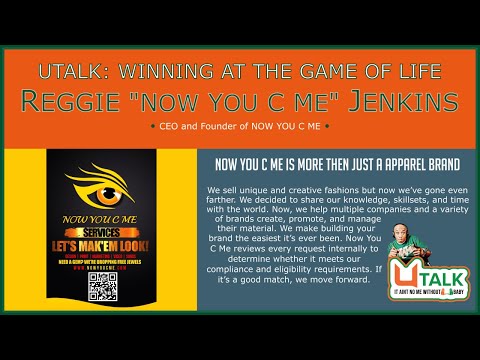
It doesn’t. It never has. And the most useful thing to come out of a recent Winning At The Game Of Life conversation with Reggie Jenkins — founder and CEO of the apparel and branding company Now You See Me — wasn’t a business tip or a hustle slogan. It was a correction to that lie. Because the way Reggie builds, the seeing isn’t the reward at the end. The seeing is a job. It has steps. It has a bill. And most people skip every single one of them.
The Part Everybody Fast-Forwards Through
Run down what Now You See Me actually delivers a client and you’ll notice something strange about the list. Brand concept. An original theme song, written from scratch specifically so nobody gets tangled up in copyright. A model photo shoot. Video production. A digital ad campaign. Printed flyers. And then — this is the one that stops you — a street team that physically puts those flyers in human hands.
Look at that list again. Almost none of it is the product. The clothes are in there somewhere, but the majority of that pipeline is the connective tissue between having something and having somebody know about it. Reggie calls that the in-between, and he’s blunt that it’s the stretch most people sprint past on their way to what they imagine the finish line looks like.
That’s the whole insight, and it’s worth sitting with. The average person’s mental model of building a brand has two nodes: make it and blow up. Reggie’s model has about nine, and eight of them are unglamorous. Nobody dreams about flyers. Nobody’s vision board has a street team on it. But that’s the part that turns a good idea into a thing that exists in the world, and the reason so many good ideas die quietly is that their owners were only ever willing to do the fun node.
Printed Flyers in 2021 Is Not a Typo
Here’s what I keep chewing on. This is a shop that does video production and digital ad rollouts — it is fully capable of living entirely on a screen. And it still puts paper in people’s hands.
That’s not nostalgia. That’s a read on what attention actually costs now. Digital is cheap to start and brutal to win; everybody has the same tools, the same platforms, the same algorithm deciding whether today is your day. A flyer handed to somebody by a person standing in front of them doesn’t get throttled. It doesn’t get buried under a reach change. It’s a channel most competitors have abandoned entirely, which is precisely why it still has room in it.
The lesson isn’t “go print flyers.” The lesson is that a serious operator runs the channel that works rather than the channel that’s fashionable, and is completely unembarrassed about it. There’s an enormous amount of ego wrapped up in wanting your come-up to look a certain way. Reggie’s version of the pipeline is what it looks like when you strip that out and just optimize for being seen.
The Theme Song Tell
Small detail, big signal: original theme songs, written in-house, so clients don’t inherit somebody else’s copyright problem.
That is not a creative flourish. That is a man who has been around entertainment and branding for two decades and has watched what happens when a brand builds its identity on borrowed audio and then has to tear it all down. Writing the song from scratch costs more up front and saves everything later. It’s defensive engineering disguised as a creative service.
You learn more about an operation from a decision like that than from any mission statement. Anybody can say they’re professional. Building the copyright landmine out of the process before the client even knows the landmine exists — that’s twenty years of scar tissue doing its job.
The Handshake Where You Give It All Away
The design process is where Now You See Me plants its flag hardest, and it’s worth walking through because the shape of it says everything.
Payment comes first. The customer sends reference examples of what’s in their head. The team builds three or four mockups. Rough sketches get drawn by hand and then digitized. And at the end, the finished design belongs one hundred percent to the customer. No ownership retained. None.
Take those two ends together, because they’re the same philosophy pointed in opposite directions. Payment up front is a boundary — it says my time is not speculative, and it filters out everybody who wants to browse for free. Full ownership at the end is generosity — it says once this is yours, it is entirely yours, and I’m not going to build my leverage out of a clause you didn’t read.
Plenty of shops do neither. Plenty do the first and not the second, which is how you get the classic trap: you paid for a logo and somehow still don’t own it. Doing both is a specific choice about what kind of business you want to have. You get paid on the front end so you don’t have to squeeze on the back end. Clean transaction, no hooks, client walks away with the goods. That’s a business built to be recommended, not just sold to once.
What the Name Is Actually Doing
Now You See Me sounds like a clever brand name until you hear what it’s pointed at. It’s the sentence you say to the person who counted you out. It’s for the moment somebody doubted you and you went and did it anyway. Reggie’s been direct that he’d rather people buy into that statement than into the fabric.
What makes that land is that the name is also a description of the service. The company literally sells visibility — photo shoots, video, ad campaigns, boots on the ground getting your name in front of humans. The emotional promise and the operational deliverable are the same promise. You came in invisible; the pipeline’s job is that you don’t leave that way. Most brand slogans are decoration. This one’s a spec sheet.
Where the Ceiling Is
The stated five-year target is a four hundred thousand square foot warehouse, at least fifty employees on real salaries, and product in every state in the country — with the hope of hitting it in three instead of five. But the piece of that vision that says the most is the flagship store built to give back every month, specifically to single fathers.
That’s a deliberately chosen blind spot. Brands line up to support mothers and kids, and they should. Single fathers get comparatively little of that attention, which means it’s exactly the kind of gap somebody has to decide on purpose to fill. It’s the same instinct as the flyers, honestly — go where the room is, not where the crowd is.
And notice that the goal isn’t phrased as an exit or a valuation. It’s square footage, headcount, and good salaries. That’s a man measuring success in how many people he can carry, not how fast he can cash out.
The Takeaway
If you’re building anything right now — a brand, a business, a name — the transferable part isn’t the warehouse number. It’s this: budget for the in-between. Assume nobody will find you. Assume the work does not speak for itself and never has. Then go build the unglamorous machinery that puts it in front of people, and don’t be too proud to run the channel that actually works.
The doubters aren’t going to see you because you got good. They’re going to see you because you made them.
This take grew out of a Winning At The Game Of Life sit-down with Reggie Jenkins of Now You See Me, where he laid out the full pipeline his clients get and the in-between work most people skip.
This take grew out of the October 13, 2021 episode — watch it here: U TALK Winning at the game of life- Reggie Jenkins