
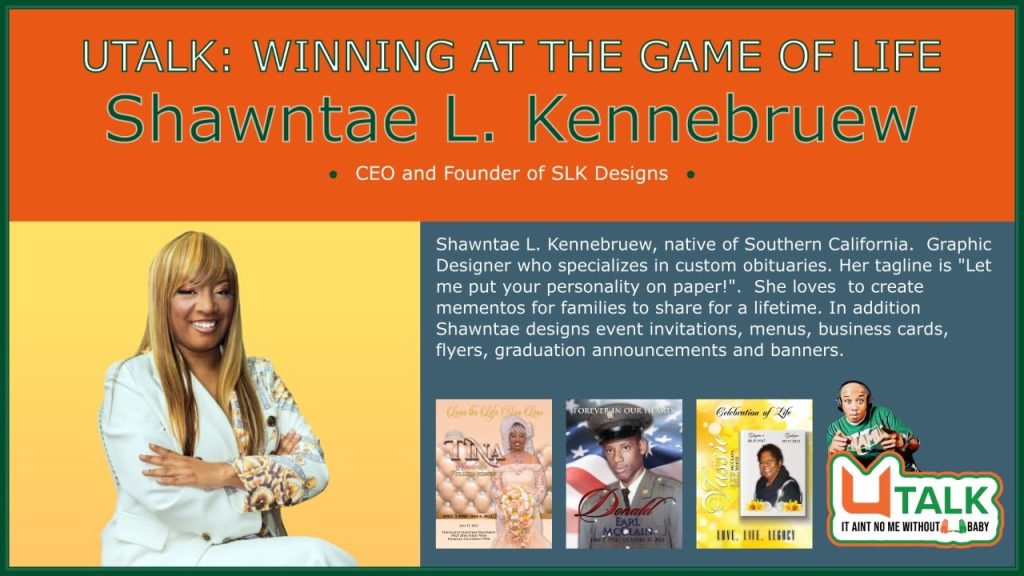
There’s a whole category of work nobody puts on a vision board. Nobody’s twelve-year-old self says “I want to design memorial booklets.” And yet here’s Shawntae L. Kennebrue, the Southern California graphic designer behind SLK Designs, telling us straight up that custom memorial booklets and obituaries are her biggest seller — and that she considers that line of work her true ministry. Not her side hustle. Not the thing she does while she waits for the fun jobs. Her ministry.
THE RUNDOWN is going to sit with that one for a minute, because it says more about how real businesses actually get built than a hundred entrepreneurship podcasts do.
The Business You Get, Not The Business You Planned
Kennebrue didn’t set out to build a design company at all. Twenty-two years ago she went looking for wedding invitations she actually liked, couldn’t find them, and made her own. People saw them. People asked. People offered to pay. SLK Designs launched in 2002 out of that — a wedding-invitation habit that people kept throwing money at.
Follow the arc, though. Invitations. Banners. Corporate work. And then, during COVID, memorial booklets took off, and the thing she never planned to build became the engine of the whole operation.
That’s not a detour. That’s the actual pattern for almost every small business that survives past year five. You launch with the thing you love, and the market quietly informs you what it will pay you for. The founders who make it are the ones who listen. The ones who don’t spend a decade defending a business plan nobody asked them to write.
What makes Kennebrue’s version of that story land is that she didn’t just accept the pivot — she found meaning in it. The COVID years handed a whole lot of designers a flood of memorial work. Most treated it as volume. She treated it as calling.
What A Passport-Shaped Obituary Actually Costs You
Two pieces of her work came up that ought to be in a portfolio museum somewhere. A passport-themed obituary for a client’s mother who loved to travel. And a CD-shaped invitation styled like a vinyl record for a minister of music’s sixtieth birthday.
Read those again and think about what’s actually happening. Somebody said “my mother loved to travel,” and the designer heard “passport.” Somebody said “he’s a minister of music,” and the designer heard “make it a record.” That’s not software skill. You cannot YouTube your way to that. That’s a person listening hard enough to a grieving family or a proud congregation to find the one object that carries the whole life.
And here’s the part people underrate: that kind of listening is emotionally expensive. Every memorial booklet is a conversation with somebody on the worst week of their life. Every detail has to be right because there is no version two — the service is Saturday, the family is counting on you, and a typo in a name is a wound. Design work most people would call “just a printed program” is, in practice, high-stakes emotional labor on a hard deadline.
Which is exactly why the boundaries she’s built matter so much.
The Three-Revision Rule Is A Survival Mechanism
Kennebrue caps client revisions at three before she charges extra. On paper that’s a line item. In practice it’s the fence that keeps the whole business standing.
Creative work has no natural stopping point. There is always one more tweak, one more “can we see it in blue,” one more relative with an opinion. A designer without a revision cap isn’t running a business, they’re running a charity with a printer. Three revisions says: I will go deep with you, and then we will ship.
She goes further. She has refunded clients outright when they were disrespectful. Her words: “I have a big thing about respect.” Every freelancer reading this just sat up straight, because everybody knows the client who pays but poisons the well — the one whose money you take and then spend three weeks miserable earning. Handing that money back is one of the hardest and most profitable decisions in the whole trade, and most people never learn to do it.
Then there’s discounts. She discounts at her own discretion only — never on request. Her framing is the cleanest articulation of pricing psychology we’ve heard in a while: “me offering someone a discount is basically me paying them to get my product.”
Put those three rules side by side and you’re looking at a coherent operating philosophy, not a list of quirks. Cap the scope. Own the price. Fire the disrespect. That’s the framework doing the work, and it’s the reason a home-office operation lasted twenty-two years while flashier studios came and went.
The Invisible Overhead Nobody Warns You About
Kennebrue was candid about something the highlight reels skip: staying current costs money before a single order ships. New printers. Paper stock. Foiling. Software subscriptions. All of it eating margin on the front end, whether the phone rings or not.
This is where the “just start a business, it’s free now” crowd gets people hurt. Physical design work has hard costs and they never stop. Every quote she sends has to carry not just her time but a share of the machinery. When she declines to discount on request, that’s not attitude — that’s arithmetic. The discount doesn’t come out of some margin cushion; it comes out of her.
And she got here with no design degree. She started on Microsoft Word and Publisher — Word and Publisher — and taught herself Photoshop and Illustrator off YouTube. The passport obituary came out of that self-education. Let that be the correction to anybody who thinks the credential is the gate.
The Client Who Walked Over A Home Office
The hardest thing she named: being a woman and a person of color in a design field she says skews male. Including one client who backed out of a deal after finding out her business ran out of a home office rather than a commercial storefront.
Sit with the absurdity. The work was good enough to close the deal. The portfolio was good enough. The price was good enough. And then the address disqualified her — a detail that has zero bearing on whether a memorial booklet prints beautifully or an invitation lands in a mailbox looking like a vinyl record.
Which reframes her five-year goal entirely. She wants out of the home office and into her own design-and-print studio, full-time, with a staff of about ten — including her brother running deliveries. That reads like a normal growth plan. It isn’t only that. For somebody who’s had a deal die over a home address, the studio is also armor. It’s buying the credibility the work already earned.
THE RUNDOWN’s take: she’ll get there, and the memorial booklets are what will fund it. The business she never planned is paying for the business she’s building. That’s usually how it goes — you just have to be paying enough attention to notice when the market hands you the better idea.
This take grew out of the May 4, 2024 episode of U Talk Winning At The Game Of Life, where Devin sat down with Shawntae L. Kennebrue of SLK Designs for the full hour. Worth your time.
This take grew out of the May 4, 2024 episode — watch it here: U TALK Wining At The Game Of Life-Shawntae L. Kennebruew