
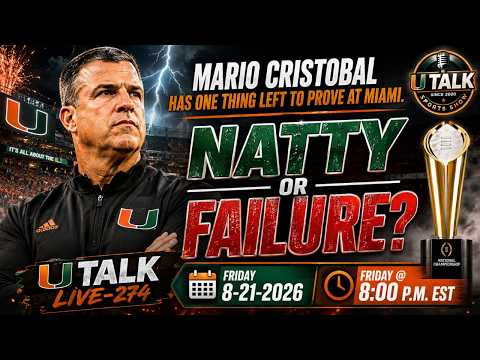
Two weeks out from kickoff on the 2026 season, the argument nobody in Coral Gables can put down is whether Mario Cristobal has to win a national championship to have his time at Miami mean anything. It’s a fair fight. It’s also the wrong frame. Because the thing that made The U The U was never the hardware itself. It was what the hardware announced: that on any given Saturday, this program was the most dangerous thing on your schedule, and everybody in the building knew it before the coin flip.
Trophies Are the Receipt, Not the Product
Here’s the trap in “championship or bust.” It makes a binary out of something that isn’t. Miami’s identity was built in an era where you could steamroll a season and get handed a crystal ball at the end of it. That’s a different sport than the one we’re watching now. Expanded playoff, portal churn every December and every May, rosters that get rebuilt on a payroll instead of a signing day. The path to a title now has more doors on it, which means more people can get through — and it also means getting through says less about you than it used to.
So if you tie the entire evaluation of a tenure to a single outcome in a tournament with that many variables, you’ve accidentally handed the verdict to luck. A fumble on a wet field. A quarterback’s ankle in November. A committee’s mood. Those things decide trophies. They don’t decide whether a program is actually good, and they sure don’t decide whether a coach did the job he was hired to do.
What decides that is whether Miami is a permanent problem for everybody else. Whether the phrase “we’ve got Miami” makes an opposing staff sigh. Whether the roster reloads instead of rebuilds. That’s the standard. The trophy is the receipt you get when the standard holds long enough and the ball bounces right.
The Money Changed the Question
Now — and this is where the “or bust” crowd earns their side of the room — Miami is not operating like a program asking for patience. When you’re funding a roster at the level The U is funding it, and when you’re winning portal cycles and recruiting battles against people who used to laugh you off, you have forfeited the excuse column. You don’t get to spend like a blue blood and evaluate like a rebuild.
That’s the real tension, and it’s got nothing to do with sentiment. It’s a resource-allocation argument. If the checks are top-five checks, the floor has to be a top-five floor. Not the ceiling — the floor. The ceiling is a title, and the ceiling is always partly weather. The floor is what you control: don’t lose to teams you outspend, don’t lose games you led, don’t get out-physicaled by anybody, ever.
By that measure the Cristobal evaluation gets a lot cleaner and a lot more uncomfortable. Nobody’s arguing the talent acquisition. The talent acquisition has been the least controversial part of this whole tenure. The argument has always lived in the fourth quarter — in whether the operation converts the raw material into the closing. That’s the file. That’s what year whatever-this-is has to answer.
What the Market Is Telling Us
Look around the sport and you can read the pricing. Brent Venables just got extended at Oklahoma at six years and $10.5 million a year. Whatever you think of that specific number, it tells you something about what programs believe they’re buying. They’re not buying a guaranteed title — nobody’s dumb enough to think they can purchase that. They’re buying stability, floor, identity, and the belief that the operation is trending the right direction. Athletic directors write those checks against a curve, not against a trophy case.
Which means the market itself already rejects “championship or bust” as an evaluation model. If it didn’t, half the coaches in this sport would be unemployed and the other half would be radioactive. The people whose actual money is on the line grade on trajectory. Fans grade on trophies. Both are legitimate — they’re just measuring different things, and pretending they’re the same thing is how you end up firing a guy who was two years from the summit.
The Failure Word Is Doing Too Much Work
“Failure” is a heavy word and Miami fans throw it like it’s light. Let’s define it properly. Failure isn’t falling short of the best possible outcome. Failure is a program that isn’t relevant. Failure is not being able to sign the guys you want. Failure is watching the kid from Northwestern High sign with somebody else because he doesn’t believe The U is where you go to get to Sunday. Failure is the stadium half-empty in October because nobody thinks the game matters.
Disappointment, on the other hand, is losing a semifinal you had every business winning. That’s brutal. That’ll ruin your winter. It’s not the same thing, and the distinction isn’t a cop-out — it’s the difference between a program that needs a new coach and a program that needs a better third down.
Here’s the honest version, though: the longer a tenure runs without the summit, the more the “disappointment, not failure” defense starts to look like a permanent residence instead of a waypoint. There’s a shelf life on that grace. Every year you use it, it gets thinner. That’s not unfair — that’s just the deal you sign when you take the job at a place with five banners hanging in it.
The Only Question That Matters in the 2026 Season
Forget the tenure verdict for a second. It’s August. Nobody’s kicked off. The referendum question for this fall isn’t “will Cristobal win a natty.” It’s simpler and it’s more answerable: does this team look like it fears anybody?
You’ll know inside of four weeks. You’ll know by how the offensive line comes off the ball on a third-and-two. You’ll know by whether the defense gets a stop when the crowd’s already halfway to the parking lot. You’ll know by whether the young receivers behind the departed guys show up ready, because that’s what a real program does — the next man isn’t a hope, he’s a plan. Those are the tells. The scoreboard in January is a consequence of those tells, not a substitute for them.
My take, plainly: Cristobal doesn’t need a national championship to have succeeded at Miami. He needs to make Miami feel inevitable again — and if he does that, the championship stops being a question and starts being a matter of time. If he doesn’t, then no amount of recruiting rankings, portal wins or roster money will save the argument, and the trophy debate becomes academic anyway. You don’t lose the job for not winning it all. You lose it for not looking like you ever will.
That’s the standard. Not a trophy. A threat. Restore the threat and the rest handles itself.
This take grew out of this week’s U Talk Live episode, where the panel spent four rounds splitting the room on whether Cristobal’s tenure lives or dies on a natty. Worth your time — the debate got real.
This take grew out of the August 22, 2026 episode — watch it here: Mario Cristobal has one thing left to prove at Miami U TALK LIVE-301