
Here’s the thing nobody says out loud at the barbershop, the tailgate, or the family cookout: there is a number attached to your name that gets evaluated before you walk in the room, and you don’t get to talk your way past it. It doesn’t care about your work ethic. It doesn’t care that you’ve never missed a shift. It looks at a file, makes a call, and moves on to the next name. Sound familiar? It should. It’s the same cold math as a recruiting board.
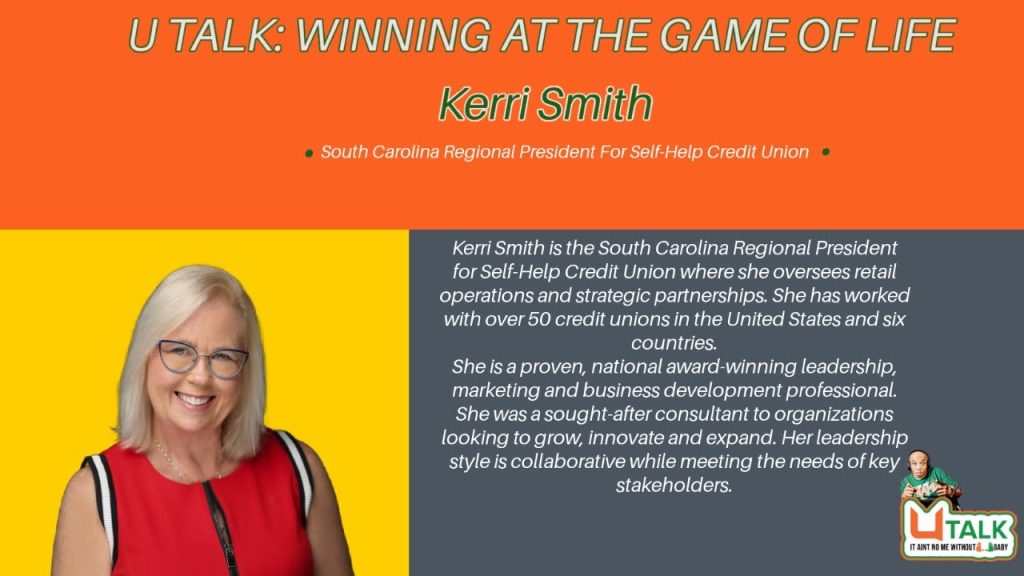
Kerri Smith, the South Carolina Regional President for Self-Help Credit Union, put it plainly when she sat down with the U Talk family: she has watched qualified engineers — engineers, people with the degree, the skills, the offer letter practically in hand — lose job opportunities over a credit score alone. Not over a background issue. Not over performance. Over a three-digit number generated by a system that, in her own honest words, rewards people who already have access and penalizes people who don’t.
Let that sit. You can be the most qualified person in the pipeline and still get cut on the paper eval.
The Rigged Game Isn’t a Conspiracy — It’s a Design Choice
What makes Smith’s take land is that she isn’t a street-corner cynic. She’s a regional president at a financial institution. She’s a published author. She ran for state legislature in South Carolina as a Republican in 2023 and missed outright by nine votes before landing in a runoff. This is not somebody with an interest in trashing the system for clicks. This is somebody inside the building telling you the building has a bad blueprint.
And that’s the part that ought to change how you think about your own money. If the game is structurally tilted, then “just be responsible” is incomplete advice. Responsibility is necessary. It is not sufficient. Because the scoring model doesn’t reward virtue — it rewards history. It rewards having already had access to credit and having used it in a very specific, very narrow way. Which means the person who paid cash their whole life, never borrowed a dime, never carried a balance, and never owed anybody anything can walk into a lender’s office and get treated like a stranger off the street. Meanwhile somebody with generational access and a co-signed card at nineteen is sitting on a decade of “history” they didn’t earn so much as inherit.
That’s not a moral judgment on either person. That’s just the film. And you can’t beat a scheme you refuse to study.
Why the Credit-Union Model Actually Matters Here
Smith laid out the structural difference between a credit union and a bank in a way that deserves more airtime than it gets: a credit union is a not-for-profit, member-owned cooperative, and every member gets one vote regardless of what their balance says. A bank answers to shareholders. That’s the whole ballgame right there in one sentence.
Think about what one-member-one-vote actually means. It means the guy with four hundred dollars in his account has the exact same say as the woman with four hundred thousand. In a shareholder model, capital votes. In a cooperative model, people vote. When you’re talking about a system that already penalizes people for not having capital, the difference between “capital decides” and “people decide” is not a technicality. It’s the difference between an institution that’s structurally incentivized to serve the folks who already made it and one that’s structurally incentivized to serve its actual membership.
That’s why Self-Help’s approach to products like credit-builder loans and share-secured cards is worth understanding as more than a product pitch. The whole design lets a member build savings and build credit in the same motion — instead of forcing you to pick one and hope the other catches up later. Smith cited a client who moved his score seventy points in six months on that model. Seventy points is not cosmetic. Seventy points is the difference between a car note that eats your paycheck and one you barely notice.
The Access Trap, Explained
Here’s the loop that catches so many people, and it’s worth naming precisely because once you see it you stop blaming yourself for it.
You need credit to build credit. But you can’t get credit without credit. So you get funneled toward the products that will take you — the high-rate stuff, the buy-here-pay-here stuff, the predatory stuff — and those products are engineered with terms that make it easy to stumble. You stumble. Your score drops. Now you’re funneled toward something worse. Repeat that cycle across a few years and the system will confidently report that you are a “high risk” borrower, when what actually happened is you got handed nothing but high-risk instruments and were expected to navigate them flawlessly with no coaching.
That’s not a character flaw. That’s a closed loop. And the reason products like a credit-builder loan or a share-secured card matter is that they’re one of the few honest doors into the loop — a way to generate the history the system demands without first surviving a predatory product to get it.
What This Means for the Young Folks Coming Up
If you’re a parent, an uncle, a coach, or an older cousin reading this — the practical takeaway isn’t “lecture them about being responsible.” They’ve heard it. The takeaway is: teach them the file exists.
Teach them that a report is being written about them right now, whether they’re participating or not. Teach them they can pull that report free at cfpb.gov and read what’s in it. Teach them that keeping utilization under thirty percent is a specific, learnable, mechanical thing — not a vibe. Teach them that on-time payments start moving the needle in something like six months to a year, which means the work is neither instant nor endless. It’s a season. Athletes understand seasons.
And teach them Smith’s rule for car buyers, because it is the single most transferable idea in the whole conversation: test drive your payment. Before you finance anything, take the proposed monthly number and save exactly that amount, on time, for three straight months. If you can do it, you can afford it. If you can’t, the dealership just found out something about your budget before you did — and the difference is that you found out for free instead of finding out at repossession.
That rule works on a car, a lease, a phone plan, a gym membership, a business loan. It’s a stress test you run on yourself. And it’s the kind of thing nobody teaches in school, which is precisely why the access gap keeps reproducing itself.
The Bottom Line
You don’t get to argue with the scoreboard. But you absolutely get to learn how points are scored — and then you go score them on purpose, methodically, over a defined stretch of time, with a lender whose charter says its members are its owners.
The system being tilted is a real thing. It’s also not an excuse, and Smith clearly doesn’t offer it as one. It’s a scouting report. The tilt tells you exactly where the pressure comes from and exactly which technique beats it. Everybody who ever won anything started by watching film on a team that was better than them.
Go pull your report. Read the file somebody else has been writing about you.
This take grew out of this week’s U Talk Winning At The Game Of Life, where Devin and Larry Frank Jr. sat down with Kerri Smith for a long, unusually candid conversation about credit, faith and building something from nothing. Worth your time in full.
This take grew out of the August 7, 2024 episode — watch it here: U TALK Winning At The Game Of Life-Kerri Smith